
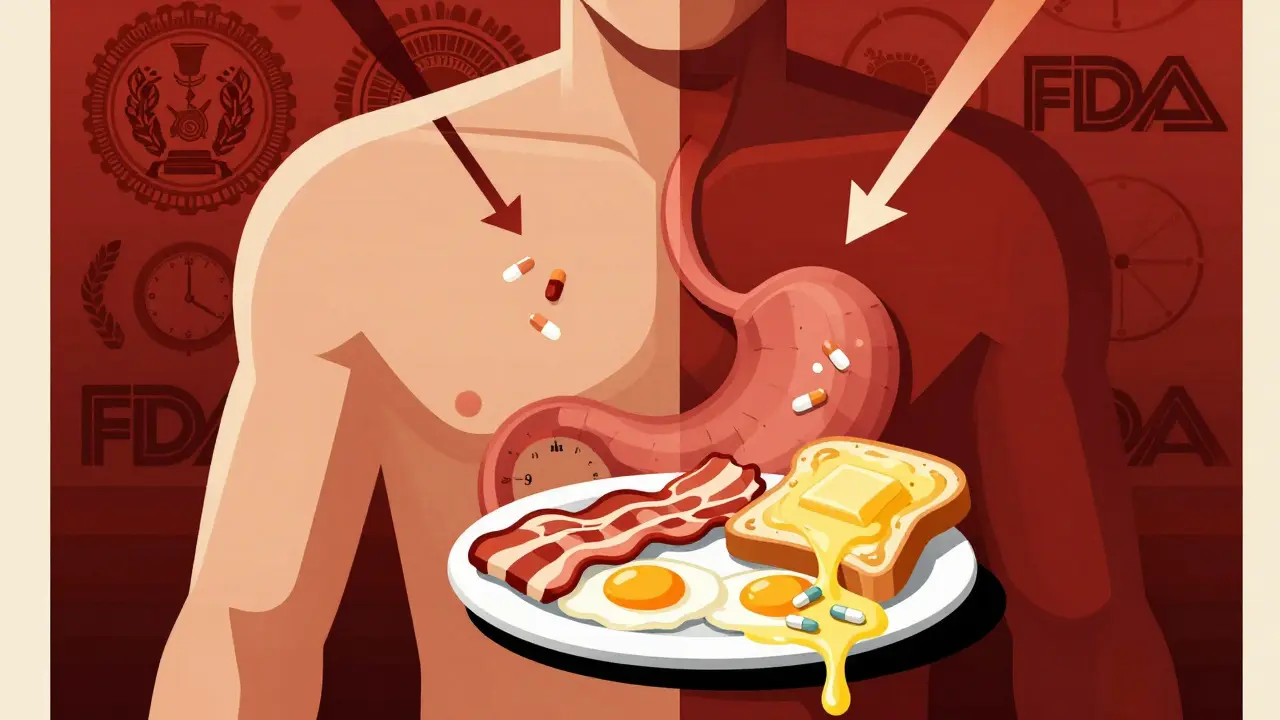
When you take a pill, does it matter if you did it on an empty stomach or right after breakfast? The answer isn’t just about avoiding upset stomachs-it’s about whether the drug actually works the way it’s supposed to. This is where fasted vs fed state testing becomes critical. These aren’t just lab quirks; they’re regulatory requirements that shape how medicines are dosed, how effective they are, and even who gets access to them.
What Exactly Are Fasted and Fed States?
Fasted state means no food for at least 8 to 12 hours. Water is allowed. Your body is running on stored energy-fat and glycogen. Fed state means you’ve eaten a standardized meal, usually high in fat and calories (around 800-1,000 kcal, with 500-600 kcal coming from fat), and you’ve waited 2-4 hours for digestion to begin.
In pharmaceutical testing, these aren’t suggestions-they’re rules. The U.S. Food and Drug Administration (FDA) and the European Medicines Agency (EMA) require both conditions for most new oral drugs. Why? Because what’s in your gut changes how drugs get absorbed. A drug might work great on an empty stomach but barely register after a meal-or vice versa.
Why Drug Absorption Changes Between States
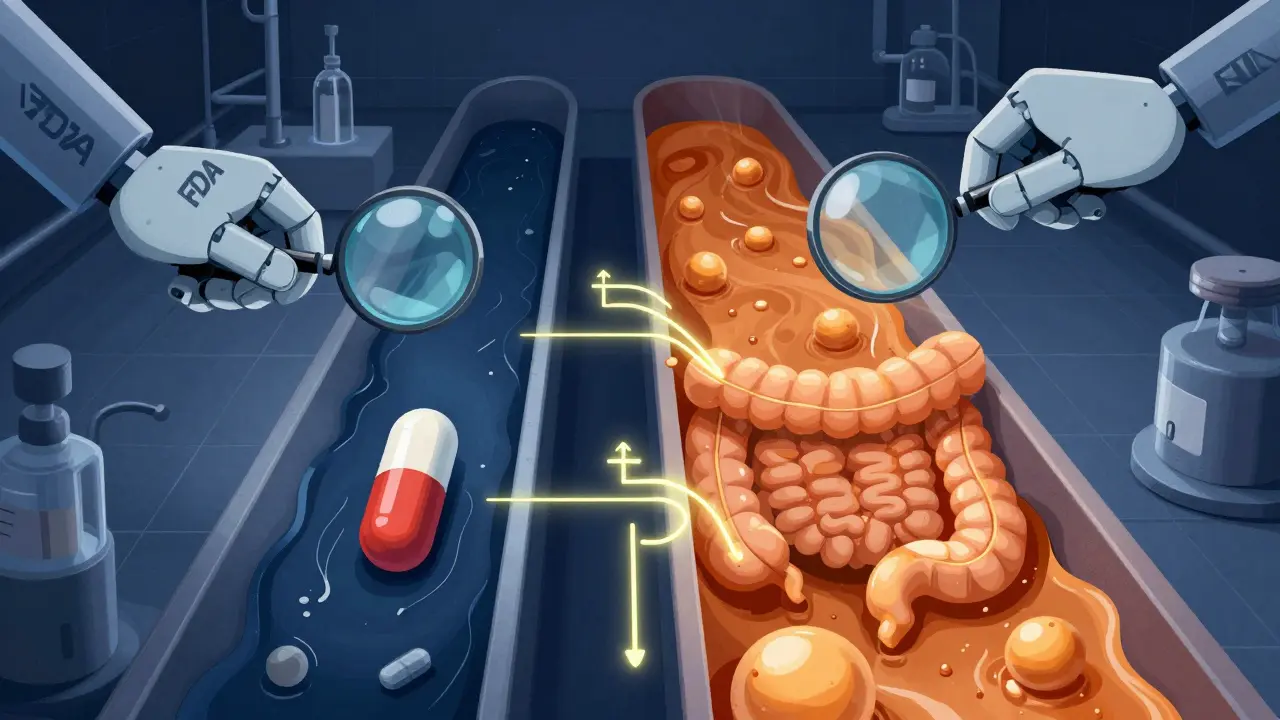
Your digestive system isn’t the same when you’re hungry versus when you’ve just eaten. In a fasted state, your stomach empties quickly-about 13.7 minutes on average. The pH is higher (around 2.5), and there’s less bile and digestive fluid. In a fed state, gastric emptying slows down to nearly 80 minutes. The pH drops to 1.5, bile flows, and stomach contractions become stronger and more consistent.
These changes directly affect drugs. For fat-soluble medicines like fenofibrate (used for cholesterol), a high-fat meal can boost absorption by 200-300%. That’s not a small bump-it means the drug could become dangerously potent if taken without food. On the flip side, drugs like griseofulvin (an antifungal) absorb 50-70% less after eating. Take it with food, and it might not work at all.
Studies using SmartPill capsules-tiny sensors swallowed to track gut conditions-showed pressure changes during digestion go from 30-304 mbar in fasted state to consistently over 240 mbar in fed state. That’s a massive shift in mechanical forces that can crush or delay a drug’s release.
Why Both Conditions Are Mandatory
Drug companies can’t just pick the condition that makes their product look best. Regulators demand dual testing because real people don’t take pills in a vacuum. Some take meds before breakfast. Others forget until dinner. A drug that works perfectly fasted but fails fed could cause treatment failure in half the population.
According to a 2019 analysis of 1,200 new drug applications, 35% of oral drugs showed clinically meaningful changes in absorption due to food. That’s one in three. The EMA now requires fed-state testing for any oral drug where food effects are unknown. The FDA’s 2023 draft guidance went further, pushing for testing across diverse ethnic groups. Research found Asian populations, for example, have 18-22% slower gastric emptying in fed states than Caucasians. That means a standard dose might be too low-or too high-for different people.
The Exercise Physiology Side of the Coin
It’s not just drugs. The same fasted vs fed debate plays out in sports science. Athletes and fitness enthusiasts have been arguing over it for years: should you train before breakfast to burn more fat, or eat first to go harder?
Studies show fasted training increases free fatty acid availability by 30-50% and boosts PGC-1α expression-the gene switch that tells your body to build more mitochondria. That’s great for endurance adaptations and metabolic health. One meta-analysis of 46 studies found fasted exercise raised post-workout fat burning by 27.6%.
But here’s the catch: you can’t sprint or lift heavy on empty. Fasted training reduces high-intensity performance by 12-15%. That’s why elite athletes like ultramarathoner Scott Jurek train fed to sustain long efforts. Meanwhile, CrossFit champion Rich Froning trains fasted to improve fat-burning efficiency.
The American College of Sports Medicine’s 2022 position stand says it plainly: fed-state exercise is better for peak performance. Fasted is fine for sedentary people looking to improve insulin sensitivity-but not for athletes pushing limits.
Contradictions and Real-World Confusion
Not everything lines up neatly. A 2021 study in the Journal of the International Society of Sports Nutrition found no difference in body composition after six weeks of fasted vs fed training, even though fat oxidation was higher during fasted sessions. That means burning more fat during a workout doesn’t always mean losing more fat over time.
Surveys of fitness communities show similar confusion. In one Reddit group, 68% of 1,247 respondents said they performed better fed. In another, 42% of 853 people preferred fasted for fat loss-but 31% reported dizziness, and 22% felt weaker during workouts.
It’s not one-size-fits-all. Genetics play a role. A 2022 study found that variants in the PPARGC1A gene explain 33% of why some people respond better to fasted training than others. Your DNA might decide whether you thrive on an empty stomach or need fuel to perform.

Practical Rules for Testing
If you’re designing a study-or just trying to optimize your own routine-standardization matters.
For pharmaceutical trials:
- Meal must be 800-1,000 kcal, with 500-600 kcal from fat
- Meal composition must be within ±10% of the standard
- Participants must fast for 10 hours minimum before testing
- Water is allowed, but no gum, coffee, or supplements
For exercise studies:
- Fasted: 8-12 hours without food, only water
- Fed: 1-4 g/kg of carbohydrates consumed 1-4 hours before exercise
- Control for sleep (7+ hours), hydration (urine specific gravity <1.020), and 24-hour sedentary period before testing
Even small deviations can skew results. A cup of black coffee, a piece of gum, or sleeping only 6 hours can alter metabolism enough to change outcomes.
The Bigger Picture: Precision and Equity
What’s emerging isn’t just a choice between fasted and fed-it’s a move toward personalized approaches. The future of both medicine and fitness lies in matching conditions to individual biology. A drug that works for a 35-year-old Caucasian man might not work for a 60-year-old Asian woman with slower digestion. A training protocol that helps a marathoner might leave a sedentary person dizzy.
The global bioequivalence testing market hit $2.7 billion in 2022, with dual-state testing making up 65% of protocols. Meanwhile, the sports nutrition market, driven by fed-state performance products, is projected to grow at 27% annually through 2030. This isn’t niche science-it’s big business, and it’s rooted in real physiological differences.
Regulators are catching on. The EMA’s 2024 update now requires continuous glucose monitoring during fed-state trials to track real-time metabolic responses. That’s a huge step toward understanding not just if a drug works with food-but how your body reacts to it over time.
Bottom Line: Context Is Everything
Fasted and fed states aren’t opposites-they’re two sides of the same coin. One isn’t better than the other. Each reveals something different. Fasted shows you how the body handles scarcity. Fed shows you how it handles abundance.
For drugs, testing both ensures safety and effectiveness across real-world conditions. For training, it helps you choose the right approach for your goals: fasted for metabolic health, fed for performance.
Ignore one side, and you’re flying blind. Test both, and you start seeing the full picture.
Why do some drugs need to be taken with food?
Some drugs, especially fat-soluble ones like fenofibrate or itraconazole, need dietary fat to dissolve properly in the gut. Without food, they pass through the system mostly unabsorbed. Taking them with a high-fat meal can increase bioavailability by 200-300%, making them effective.
Can I skip fed-state testing if my drug works fine fasted?
No. Regulatory agencies like the FDA and EMA require dual testing because real patients take medications with or without food. A drug that works fasted might fail in 30-40% of users who eat before dosing. Skipping fed-state testing risks underdosing, treatment failure, or even toxicity if food unexpectedly boosts absorption.
Is fasted exercise better for fat loss?
Fasted exercise increases fat burning during the workout by 27-50%, but studies show no consistent advantage for long-term fat loss over six weeks or more. What matters more is total calorie balance and consistency. Fasted training may help metabolic health, but it doesn’t automatically lead to more weight loss.
What’s the ideal meal for fed-state drug testing?
The FDA requires a high-fat, high-calorie meal of 800-1,000 calories, with 500-600 calories from fat. Typical examples include scrambled eggs with butter, bacon, hash browns, and whole milk. The goal is to trigger strong bile flow and slow gastric emptying to mimic real-world conditions.
Why do some people feel dizzy when training fasted?
Low blood sugar and reduced glycogen availability can cause lightheadedness, especially during high-intensity or prolonged workouts. This is more common in people who are not metabolically adapted to fasting. Hydration and electrolyte balance also play a role. If you feel dizzy, it’s a sign your body needs fuel before training.
Does genetics affect how I respond to fasted vs fed training?
Yes. Variants in the PPARGC1A gene, which regulates mitochondrial production, explain about 33% of individual differences in response to fasted training. Some people naturally adapt better to fasting, while others perform better with fuel. Personalized training based on genetics is becoming more common in elite sports and metabolic health programs.

Heather Josey
December 31, 2025 AT 14:57This is such an important topic that gets overlooked so often. I work in clinical trials, and I can't tell you how many times we've seen drugs fail in Phase III because the fed-state data was ignored in early phases. It's not just about efficacy-it's about safety across real-world populations.
Donna Peplinskie
January 1, 2026 AT 23:59Thank you for writing this! I've been trying to explain to my fitness coach why fasted training isn't magic-and now I can just send him this. The part about PPARGC1A gene variants? Mind blown. Genetics really do decide so much more than we admit.
Olukayode Oguntulu
January 2, 2026 AT 17:19Ah, the classical pharmacokinetic dichotomy-fasted versus fed, the Hegelian thesis and antithesis of gastrointestinal bioavailability! One must transcend the binary; the true synthesis lies in circadian pharmacodynamics, where enterohepatic recirculation, gut microbiome diurnal variation, and biliary excretion rhythms modulate drug absorption far beyond mere meal composition. The FDA? Still stuck in the 1980s.
jaspreet sandhu
January 4, 2026 AT 05:51People think food affects drugs but they don't realize how much it affects their own body. In India we eat spicy food, oily food, different kinds of meals, and taking medicine after such food is not same as taking it after western high fat meal. So when FDA says 800 kcal meal, it's not same for everyone. That's why many drugs don't work here even if they work in US. Simple truth.
Alex Warden
January 6, 2026 AT 03:23Why are we letting Europe and Asia dictate how Americans take medicine? We invented modern pharmacology. If your drug works in a fasted state, that's good enough. Stop overcomplicating it with global meal standards. We eat burgers and fries, not some lab-approved 800-calorie slop. Just make the pill work for real Americans.
LIZETH DE PACHECO
January 7, 2026 AT 07:56I love how this connects drug science to everyday life. My mom takes her blood pressure med with breakfast and swears it works better. Now I know why. This isn't just science-it's personal. Thank you for making it relatable.
Lee M
January 8, 2026 AT 00:07It's not about food. It's about control. The pharmaceutical industry needs standardized conditions so they can patent and profit. Real human variability? Too messy. They'd rather have 35% of drugs behave unpredictably than admit the body isn't a lab rat. This whole system is built on illusion.
Kristen Russell
January 8, 2026 AT 01:05One sentence: Fed state isn't optional-it's essential for real-world effectiveness.
Bryan Anderson
January 8, 2026 AT 01:58Interesting how the same principles apply to both pharmaceuticals and exercise physiology. I've been doing fasted cardio for years, but after reading this, I'm going to try fed-state sessions for strength training. The data on PGC-1α and mitochondrial biogenesis is compelling, but so is the performance drop. Maybe balance is the answer.
Matthew Hekmatniaz
January 9, 2026 AT 16:39As someone who grew up in a culture where meals are communal and timed differently, I appreciate how this highlights cultural bias in medical standards. In many Asian and African households, the concept of a 'standardized high-fat meal' is alien. We eat rice, lentils, vegetables, and spices-different ratios, different rhythms. The FDA’s guidelines might be scientifically sound, but they're culturally blind. We need diversity in testing protocols, not just in demographics.
Liam George
January 9, 2026 AT 17:36Think about it-what if food effects on drugs are being manipulated? The FDA and Big Pharma push fed-state testing to create 'new' dosing protocols that require more pills, more visits, more profit. The real reason they don't test across diverse ethnicities? Because they know some populations metabolize drugs slower-and they don't want to lower prices. They'd rather kill a few people quietly than admit the system is rigged.
sharad vyas
January 10, 2026 AT 00:56My grandfather in India took his medicine with tea and roti every day. He lived to 92. The science says it's wrong. But life? Life is not a clinical trial. Sometimes the human body knows better than the lab.
Dusty Weeks
January 11, 2026 AT 03:37lol so you're telling me my 3am protein shake before squatting isn't 'scientific'?? 😂 i'm gonna keep doing it anyway. also why is everyone so scared of food? 🤡