
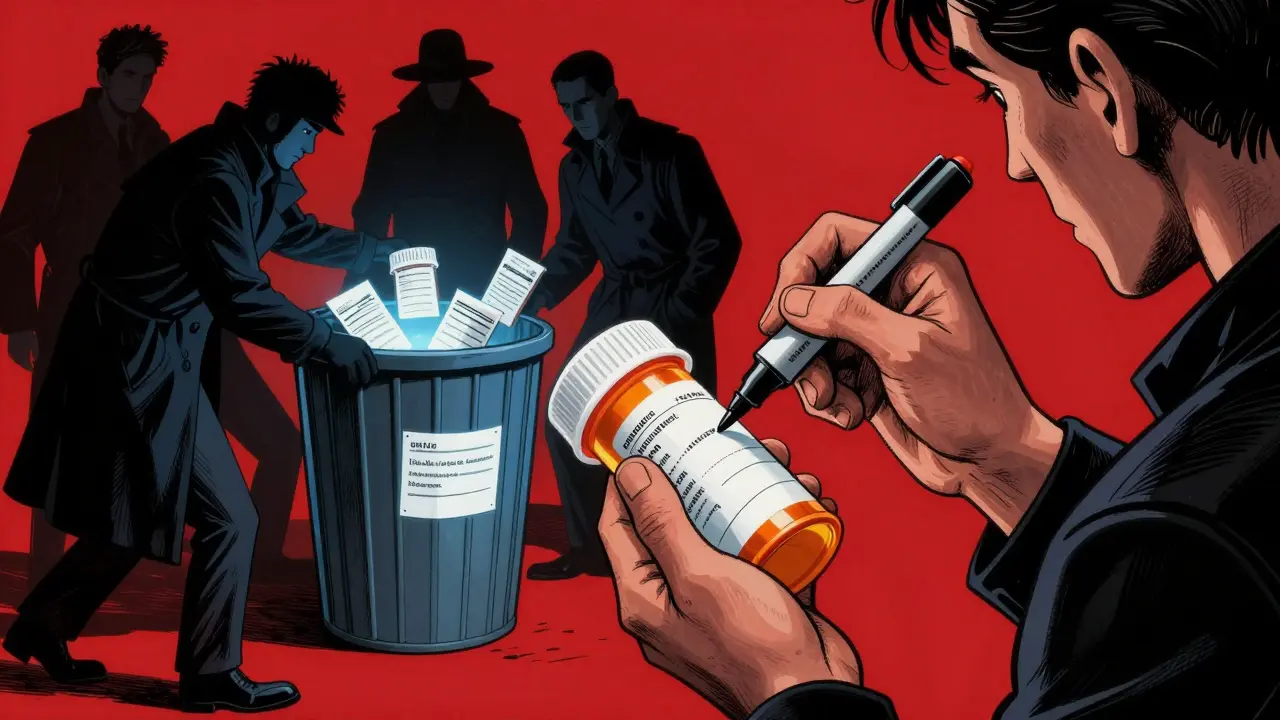
Throwing away old pills might seem like a simple chore, but if you’re not careful, you’re leaving your personal health information wide open. Prescription labels contain more than just your name-they have your address, doctor’s name, diagnosis, and even the exact medication you were taking. That’s enough for someone to steal your identity, fake prescriptions, or even sell your drugs on the black market. In 2021, a study found that 42% of prescription bottles tossed in the trash still had readable labels. And it’s not just a U.S. problem-this happens everywhere, including here in Melbourne, where people often don’t realize how risky it is.
Why Your Prescription Bottle Is a Privacy Risk
The label on your pill bottle isn’t just for pharmacy use. It’s a mini-file of your medical history. Your name, birth date, prescription number, prescribing doctor, dosage, and condition (like "for anxiety" or "for diabetes") are all printed there. If someone finds that bottle in your recycling bin or trash, they can use that info to apply for credit cards, file false insurance claims, or even get more pills under your name. The Department of Health and Human Services calls this Protected Health Information (PHI), and it’s protected under HIPAA rules-even when it’s in your trash.Most people think, "I’ll just throw it in the bin." But a 2023 Consumer Reports survey showed that 54% of Americans didn’t even know prescription labels could be used for identity theft. That’s a dangerous gap in awareness. You don’t need to be a hacker to steal your data-just someone who goes through the garbage.
The Best Way to Dispose: Take-Back Programs
The safest, most private way to get rid of unused or expired medications is through a drug take-back program. These are run by law enforcement, pharmacies, or local health departments. In Australia, you can drop off unwanted meds at participating pharmacies-many of them have dedicated bins. In the U.S., the DEA runs National Prescription Drug Take Back Days twice a year, with over 6,000 collection sites in 2024. But you don’t have to wait for those days. Many pharmacies like Walgreens, CVS, and local independents offer year-round drop-off bins.Why is this the best option? Because your meds go straight into a secure container. No one sees your name. No one touches your bottle. The drugs are destroyed under federal supervision. According to a 2024 Pharmacy Times poll, 89% of people who used take-back programs felt "very confident" their privacy was protected. That’s compared to just 32% of those who disposed of meds at home.
Mail-Back Envelopes: A Private Alternative
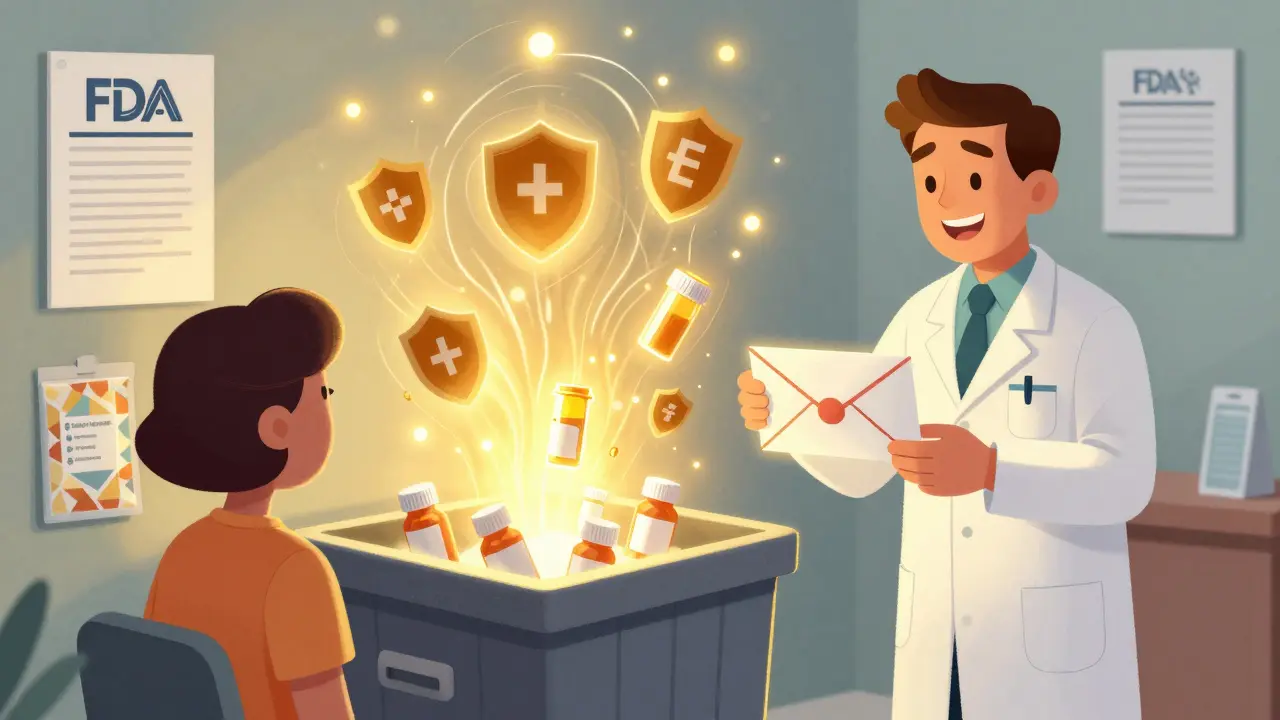
If you can’t get to a drop-off location, mail-back envelopes are the next best thing. Companies like Walgreens and DisposeRx sell these for around $3 to $7. You put your pills in the envelope, seal it, and drop it in the mailbox. The envelope has a special lining that neutralizes the drugs, and your name stays on the original bottle-never on the envelope. The package goes directly to a licensed disposal facility. No one sees your personal info along the way.This method is especially useful for people in rural areas or those with mobility issues. It’s more private than trash disposal and more convenient than driving to a pharmacy. Just make sure you use a reputable provider-check with your pharmacist or pharmacy chain for approved options.
At-Home Disposal: Do It Right or Don’t Do It
If you have no other choice, you can dispose of meds at home-but only if you follow the FDA’s 5-step process exactly:- Take pills out of their original bottles.
- Mix them with something unappetizing-used coffee grounds, cat litter, or dirt.
- Pour the mixture into a sealable container like a jar or plastic bag.
- Scratch out or cover every bit of personal info on the empty bottle with a permanent marker or duct tape.
- Throw the sealed container in the trash.
Step 4 is where most people fail. A 2022 Mayo Clinic study found that 68% of people either skip this step or do it poorly. Just peeling off the label doesn’t work-adhesive often leaves traces. A Sharpie Industrial marker ($5 a pack) works better than a regular pen. Duct tape over the label is also effective. Don’t just write over it-go over it multiple times. If you’re unsure, use a nail file or sandpaper to scratch the ink off.
What About Those "Flush List" Drugs?
Some medications are so dangerous if accidentally ingested-especially by kids or pets-that the FDA says you should flush them immediately. This list includes powerful opioids like fentanyl patches, certain painkillers, and seizure meds. As of May 2024, the FDA updated the list: three new drugs were added, one was removed. You can find the current list on the FDA website or ask your pharmacist.Don’t flush everything. Only flush what’s on the list. Flushing other meds harms the environment. But for those high-risk drugs, flushing is the only way to prevent accidental overdose. And yes, even if your name is still on the bottle, flushing it is safer than leaving it in the trash. After flushing, destroy the label with a marker before tossing the bottle.
Deactivation Pouches: A One-Step Solution
Products like DisposeRx pouches are gaining popularity because they combine privacy and safety in one step. You pour your pills into the pouch, add water, shake it, and seal it. The powder inside turns the meds into a gel, making them unusable. The pouch also destroys the label’s ink if you put the bottle inside with the pills. Some pouches even have a built-in label cover.These cost about $1.50 to $3 each and are sold at many pharmacies. They’re especially helpful for older adults who find the multi-step process confusing. A 2024 Yelp review called it "finally a simple privacy solution." But remember: even with a pouch, you still need to remove or cover the label if you’re not putting the bottle inside.
What NOT to Do
Don’t flush meds unless they’re on the FDA’s list. Don’t just rinse the bottle and toss it in recycling. Don’t leave bottles on the counter or in the bathroom cabinet-someone might find them. Don’t assume "no one will look"-identity thieves actively search through trash for medical info. And don’t rely on the pharmacy to remove your info-they’re not legally required to do it for you.Why This Matters More Than You Think
In 2023, the IBM Cost of a Data Breach Report found that healthcare data breaches cost $498 per record. That’s more than any other industry. And a lot of those breaches start with a discarded pill bottle. One Reddit user shared how someone used her old oxycodone bottle to get more pills and ran up $1,200 in fraudulent insurance charges. That’s not rare. It’s happening every day.It’s not just about money. It’s about control over your health data. You didn’t choose to share your diagnosis with strangers. But if you don’t protect your labels, you’re giving that control away.
What’s Changing in 2025 and Beyond
The federal government is taking this seriously. In March 2024, the HHS announced increased enforcement against clinics and pharmacies that don’t properly dispose of PHI. In 2025, new HIPAA guidelines are expected to require clearer instructions for patients on how to destroy labels. By 2027, 40% of major pharmacies are projected to install smart kiosks that automatically shred labels and neutralize meds-all in one touch.For now, the best defense is simple: know the steps. Use take-back programs when you can. If not, use mail-back or deactivation pouches. And always, always destroy the label.
Can I just throw my pill bottle in the recycling?
No. Recycling facilities don’t remove personal information. Even if the bottle looks clean, traces of your name, address, or prescription number can still be read. Always remove or destroy the label before recycling the plastic. Some local councils accept empty bottles only after the label is fully removed-check your local guidelines.
What if I can’t find a take-back location near me?
Use a mail-back envelope or a deactivation pouch. Both are available at most pharmacies. If neither is an option, follow the FDA’s 5-step at-home method: remove pills, mix with coffee grounds or cat litter, seal in a container, destroy the label, and throw it in the trash. Don’t skip the label step-even if it’s annoying.
Do I need to remove the label from every bottle?
Yes. Every bottle-even ones that are empty-contains your PHI. That includes bottles for vitamins, supplements, or over-the-counter meds if they came with a prescription label. If you’re unsure, assume it’s sensitive. It’s better to be safe than sorry.
Is it safe to flush medications?
Only if they’re on the FDA’s Flush List. Flushing other drugs harms water systems and wildlife. The list includes high-risk drugs like fentanyl patches, oxycodone, and certain seizure medications. Check the current list at fda.gov or ask your pharmacist. If you’re unsure, don’t flush-use a take-back program instead.
Why do pharmacies say they can’t remove my label for me?
Pharmacies aren’t legally required to remove labels. Their job is to dispense medication, not manage disposal. While some may help, you can’t count on it. Protecting your privacy is your responsibility. Always assume you need to handle the label yourself.
Are there apps to help me know what to do with my meds?
Yes. The DisposeRx app (free on iOS and Android) lets you scan your prescription label and tells you if the drug is on the FDA Flush List, if it’s safe for take-back, or if you need to use a pouch. Many pharmacies also have disposal guides on their websites. Use them.
Raushan Richardson
December 26, 2025 AT 21:28I used to just toss my old pill bottles in the recycling until I found out someone could use my label to fake a prescription. Now I use those DisposeRx pouches-they’re like $2 at CVS and I just shake, seal, and trash. No more stress. Seriously, do this.
John Barron
December 27, 2025 AT 13:46It is imperative to underscore the fact that the improper disposal of pharmaceuticals constitutes a material breach of the Health Insurance Portability and Accountability Act (HIPAA), as delineated in 45 CFR § 164.502. Furthermore, the presence of Protected Health Information (PHI) on discarded containers represents a non-compliant data handling practice, which may expose entities to civil penalties up to $50,000 per violation. The FDA’s guidelines, while advisory, are not legally binding upon individuals; therefore, personal accountability is non-negotiable.
Liz MENDOZA
December 28, 2025 AT 17:36Thank you for writing this. I’m a nurse and I see so many elderly patients who just dump their meds in the trash because they don’t know better. I always hand them a Sharpie and a little bag of coffee grounds when I give them a new script. It’s such a small thing, but it saves people from so much heartache. You’re doing good work.
Will Neitzer
December 30, 2025 AT 08:04The assertion that pharmacies are not legally obligated to remove labels is accurate, yet the systemic failure to provide patients with accessible, cost-free label-destruction tools constitutes a latent public health hazard. The absence of standardized, pharmacy-integrated de-labeling mechanisms reflects a critical gap in healthcare consumer protection policy. One cannot reasonably expect laypersons to be forensic data sanitization experts.
Janice Holmes
December 31, 2025 AT 16:33OMG I JUST REALIZED MY MOM THREW OUT HER OXYCODONE BOTTLE LAST WEEK AND SHE HAS A HISTORY OF DEPRESSION AND I THINK SOMEONE MIGHT HAVE FOUND IT?? I’M SICK TO MY STOMACH. WHY DOESN’T THE GOVERNMENT DO SOMETHING?? I’M CALLING MY CONGRESSMAN RIGHT NOW.
Olivia Goolsby
December 31, 2025 AT 16:46Let me tell you something-this whole thing is a distraction. The government wants you to think it’s about privacy, but it’s really about control. They don’t want you to know how many of these drugs are being diverted to black markets by insiders. The DEA’s take-back program? A front. They’re tracking who drops off what, and if you’re on the list, your name goes into a database. You think your info’s safe? They’re selling it to insurers. I’ve seen the leaks. Don’t fall for it. Burn the bottle. That’s the only real way.
Alex Lopez
December 31, 2025 AT 21:08So… you’re telling me the FDA has a list of drugs you can flush… but you’re not allowed to flush the rest? And yet, your local water treatment plant can’t filter out pharmaceuticals anyway? So we’re supposed to risk identity theft to protect the fish? 😒 I mean… clever.
Monika Naumann
January 1, 2026 AT 07:32As an Indian citizen, I find this Western obsession with pill bottles absurd. In our country, we do not hoard medications like hoarders. We use them, we finish them, and if there is leftover, we give it to someone who needs it. Privacy? We do not treat medicine as a secret. This is a culture of fear, not care.
Elizabeth Ganak
January 2, 2026 AT 13:37lol i just put my empty bottles in the recycling and call it a day. no one’s gonna steal my meds. i’m not rich, i’m not famous, i’m just a girl who takes ibuprofen. chill out.
Nicola George
January 4, 2026 AT 06:58Y’all are acting like this is the first time someone’s thought about this. My grandma in Cape Town used to crush her pills, mix ’em with hot sauce, and bury them in the garden. No label. No fuss. No drama. We didn’t need apps or pouches. We had common sense.
Babe Addict
January 4, 2026 AT 14:53Actually, the whole ‘destroy the label’ thing is a myth. I work at a waste facility. We see 500+ bottles a day. No one’s ever traced a single identity from a pill bottle. The real threat is corporate data breaches-not your neighbor digging through your trash. You’re being manipulated into overthinking a non-issue.
Kishor Raibole
January 5, 2026 AT 18:37It is a well-documented fact that the disposal of pharmaceuticals in accordance with municipal guidelines is a legal obligation under the Environmental Protection Act of 1999. Furthermore, the failure to comply with the prescribed methods of de-identification constitutes a violation of Article 12 of the International Convention on the Rights of the Patient. The assertion that this is a personal responsibility is legally unsound.
Miriam Piro
January 7, 2026 AT 15:52Have you ever stopped to think that maybe the whole system is designed to make you paranoid? They give you pills, they print your life story on the bottle, they tell you to destroy it… but then they track your take-back visits, your mail-back envelopes, your pouch purchases. Who’s watching? Who’s collecting this data? It’s not about privacy-it’s about building a medical surveillance state. And you’re helping them do it by following the rules. The real rebellion? Don’t take the meds. Don’t get the label. Don’t play their game.
dean du plessis
January 8, 2026 AT 06:43Been doing the coffee grounds trick for years. Works fine. Just make sure you mix it good. No one’s gonna dig through a stinky jar of sludge. And yeah, scratch the label. Or just throw the bottle away without the cap. People are lazy, not thieves.