
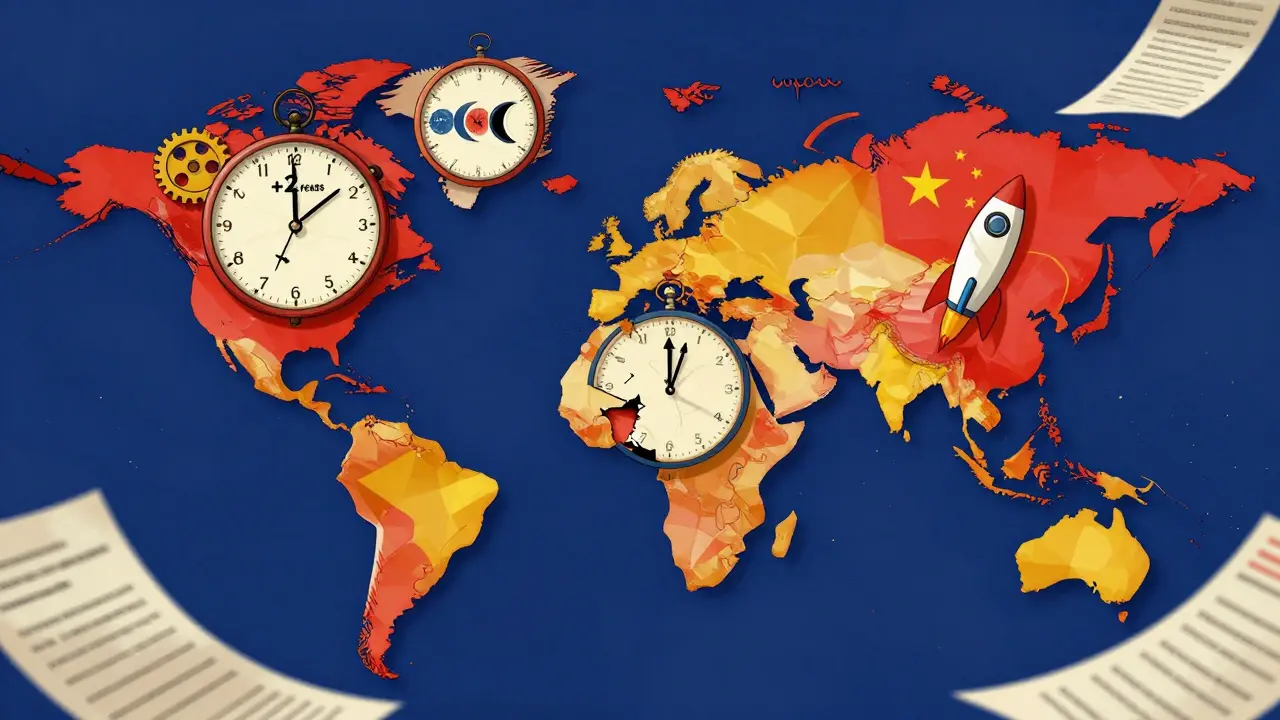
When a company spends millions developing a new drug or medical device, they rely on patents to protect their investment. But here’s the catch: patent expiration isn’t the same everywhere. A patent that lasts 20 years in the U.S. might expire sooner-or later-depending on where you look. This isn’t just a legal technicality. It affects drug prices, generic competition, and how companies plan their global strategy.
Why Patent Terms Aren’t Global
For decades, countries set their own patent rules. The U.S. used to give patents 17 years from the issue date, not the filing date. That meant if the patent office took five years to approve an application, the inventor got 12 years of actual protection. Other countries had different rules. In Japan, patents expired 15 years after filing. In Germany, utility models-shorter-term patents for incremental inventions-lasted only six years. All that changed in 1995. The TRIPS Agreement, part of the World Trade Organization’s rules, required all member countries to grant patents for at least 20 years from the filing date. Today, every major economy follows this standard. But that’s where the harmony ends.The 20-Year Rule-And the Loopholes
Yes, most countries now use 20 years from the filing date. But that’s just the starting point. Real expiration dates are shaped by delays, extensions, and fees. In the United States, if the Patent Office takes too long to examine your application, you get Patent Term Adjustment (PTA). In 2022, the average U.S. patent received 558 extra days of protection because of these delays. Some patents got over two extra years. That’s not a bonus-it’s compensation for government backlogs. Pharmaceutical patents face another layer. The FDA approval process can take years. To make up for lost time, the U.S. allows Patent Term Extension (PTE) under the Hatch-Waxman Act. A drug patent can be extended by up to five years, but only if the total time from filing to market approval doesn’t exceed 14 years. That means a drug filed in 2010 and approved in 2020 might get its patent extended to 2030. Europe has a similar system called Supplementary Protection Certificates (SPCs). These can add up to five years to a patent, plus six months if the drug was tested in children. But SPCs only apply to human medicines, not medical devices or diagnostics. China and Japan also offer term extensions for unreasonable examination delays. China introduced this in 2021. Japan requires delays of more than three years in examination before a patent can be extended. Brazil, on the other hand, has no extension system-and a massive patent backlog. Many patents there expire before they’re even granted.What Happens If You Don’t Pay?
A patent isn’t yours just because it’s issued. You have to pay maintenance fees to keep it alive. Miss a payment, and the patent dies-even if you’re only one day late. In the U.S., fees are due at 3.5, 7.5, and 11.5 years after grant. You get a six-month grace period, but you’ll pay extra. In Europe, fees are paid annually after grant. In Mexico, you pay at 5, 10, 15, and 20 years. Switzerland? Only one payment, right after grant. Many small companies and startups let patents lapse because they can’t afford the fees. That’s why you’ll see expired patents on old drugs or medical devices-sometimes years before their 20-year term should end.Utility Models: The Short-Term Alternative
Not every innovation needs 20 years of protection. That’s where utility models come in. Available in over 50 countries-including China, Germany, Japan, and Australia-they offer faster, cheaper protection for technical improvements that don’t meet the full novelty bar for a patent. These typically last 6 to 10 years. In Germany, you can get one in under a year. In China, utility model applications are examined quickly and cost a fraction of a full patent. Many companies use them to protect minor upgrades to medical devices, packaging, or diagnostic tools. But here’s the catch: utility models aren’t recognized in the U.S., Canada, or the UK. If you file a utility model in China, you can’t enforce it in the U.S. You need a separate patent.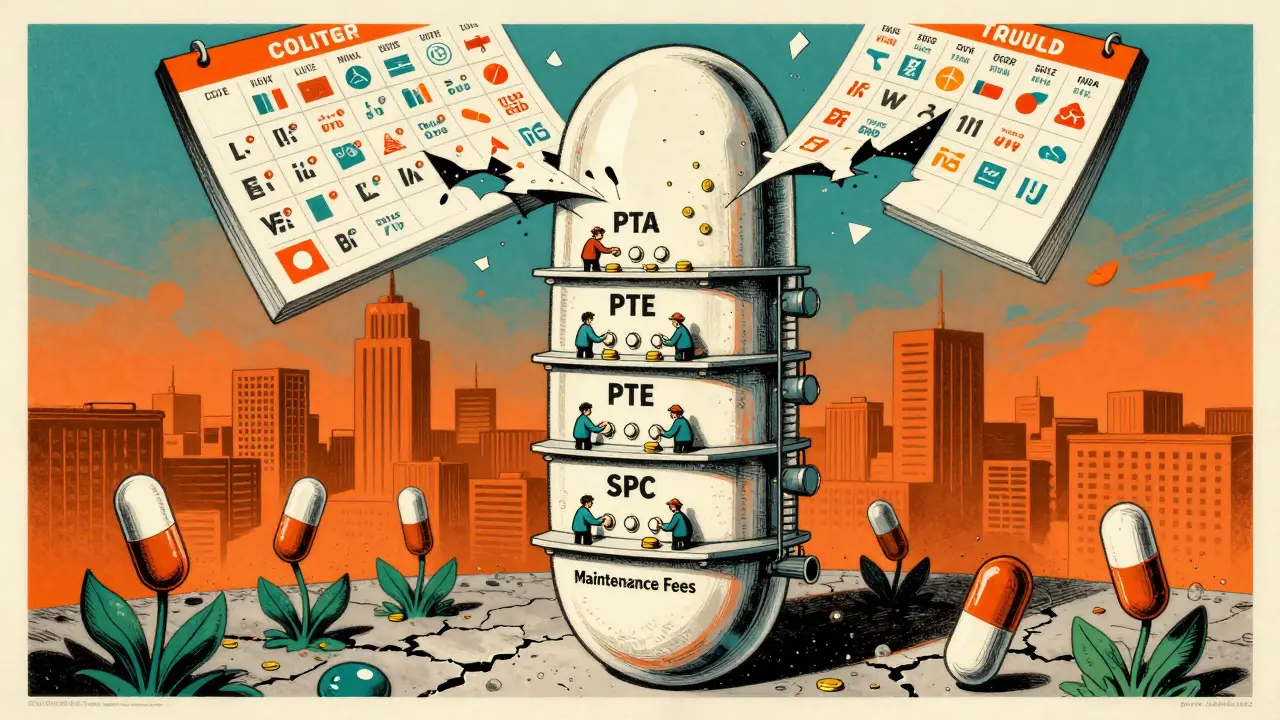
The PCT System: Delaying the Decision
Filing patents in 20 countries sounds expensive-and it is. That’s where the Patent Cooperation Treaty (PCT) helps. It lets you file one application that preserves your rights in 157 countries for 30 or 31 months after your first filing. You don’t get an international patent. You get time. During those 30 months, you can test the market, raise funding, or wait for clinical trial results before spending $50,000+ to enter each country’s national phase. Most countries allow 31 months. The U.S. and Canada accept 30. Japan gives you a two-month extension if you ask. Missing the deadline means losing rights in that country forever.What About the New EU Unitary Patent?
In June 2023, the European Union launched the Unitary Patent. It’s a single patent that covers 17 EU countries without needing separate validations in each one. The term is still 20 years from filing. But now, instead of paying renewal fees in Germany, France, Italy, and Spain separately, you pay one fee to the European Patent Office. This doesn’t change the expiration date. But it makes managing a patent portfolio across Europe much simpler. For pharmaceutical companies with products sold across the EU, this reduces administrative costs and the risk of missing a payment.Why This Matters for Drug Companies
For companies like Pfizer or Johnson & Johnson, patent expiration isn’t just a date on a calendar. It’s a financial deadline. A drug that loses patent protection in the U.S. in 2027 might still be protected in Brazil until 2029, in India until 2031 (if it’s not on the generic list), and in South Africa until 2028. Companies plan generic launches, licensing deals, and price drops around these dates. Some even use "patent thickets"-filing dozens of minor patents on formulations, delivery methods, or uses-to delay generics. One drug might have 50+ related patents. When the main one expires, another one kicks in. A 2021 study found that for every one-year reduction in effective patent term, multinational drug companies cut R&D spending by 3.2%. That’s how much this system affects innovation.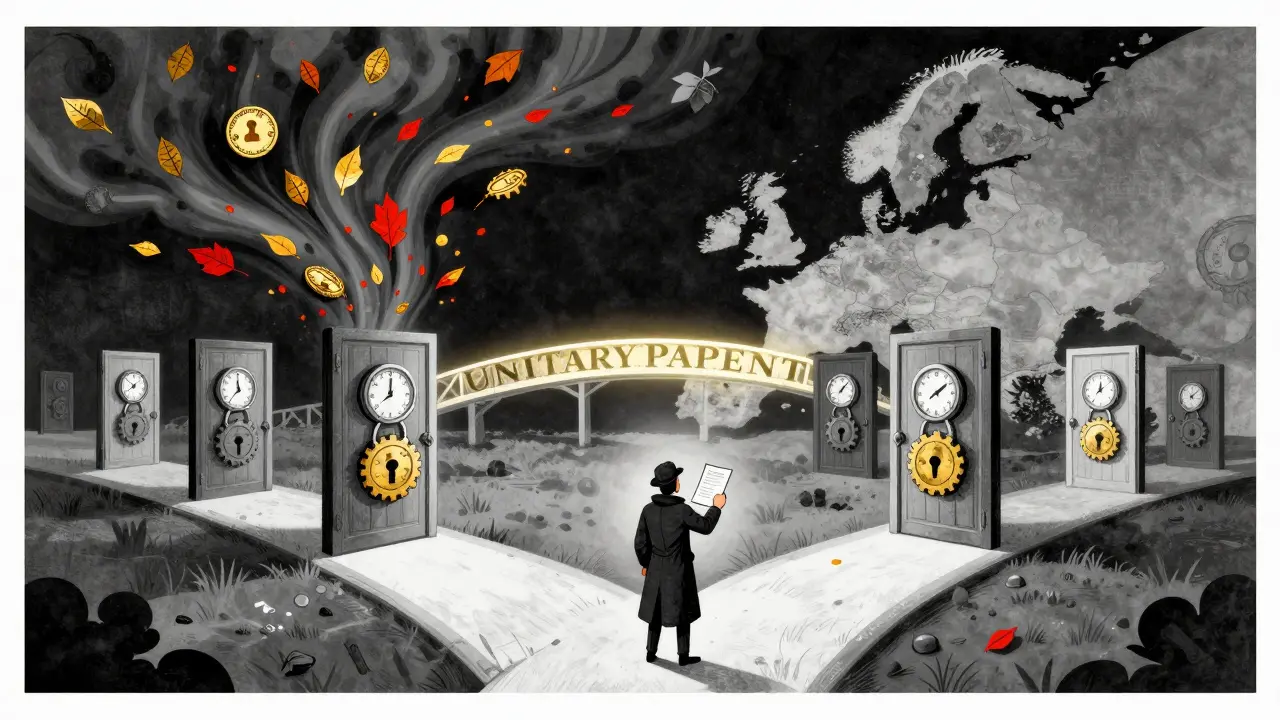
What’s Changing Now?
Emerging economies are catching up. Indonesia extended its patent term from 15 to 20 years in 2016. Vietnam did the same in 2022. Even countries like Nigeria and Kenya are moving toward TRIPS compliance. But tensions remain. Developing nations argue that long patent terms block access to affordable medicines. The U.S. and EU push for stronger protections. The World Trade Organization’s TRIPS Council is still debating whether to require term extensions for regulatory delays in all countries. Right now, the system is a patchwork. One patent. 20 years. But 20 different expiration dates.How to Track Patent Expiration
If you’re managing a global patent portfolio, you need tools. Free databases like WIPO’s PATENTSCOPE or the USPTO’s PAIR system show basic dates. But for accuracy, you need software that accounts for:- Priority dates
- PTA and PTE calculations
- Maintenance fee schedules
- Country-specific grace periods
- Utility model vs. patent distinctions
kumar kc
January 21, 2026 AT 01:04Patents are just corporate welfare. If you can't innovate without 20 years of monopoly, you never should've started.
Stop hiding behind legal loopholes and actually build something better.
Thomas Varner
January 22, 2026 AT 05:46Okay, so... let me get this straight.
They give you 20 years... but then the US adds like 2 extra years because the patent office is slow??
And then pharma gets another 5 if they take too long getting FDA approval??
And then you still gotta pay maintenance fees or it just... vanishes??
And in Brazil?? Some patents expire before they're even approved??
And utility models?? Those are like... the 'lite' version??
And the EU just dropped this unitary patent thing??
And Japan gives you two extra months if you ask nicely??
And China? They're catching up??
And people are still acting like this is 'fair'??
I'm not even mad... I'm just impressed at how many ways this system can break your brain.
Also, PTA = Patent Term Adjustment? I had to Google that. That's not common knowledge, folks.
Art Gar
January 23, 2026 AT 07:26The notion that patent term adjustments constitute a legitimate form of compensation is a fallacy rooted in institutional capture. The patent office's administrative inefficiencies are not the responsibility of the public, nor should they be subsidized through the extension of monopolistic rights. This constitutes a perverse incentive structure wherein bureaucratic failure is rewarded with prolonged market exclusivity, thereby distorting the very economic calculus upon which the patent system is ostensibly predicated. Furthermore, the differential treatment of pharmaceuticals under PTE and SPC regimes introduces an unjustifiable hierarchy of innovation, privileging certain industries over others without empirical justification. The TRIPS Agreement, while nominally harmonizing standards, has merely exported American-style rent-seeking to the global stage, thereby exacerbating inequities in access to essential medicines. One must question whether the preservation of intellectual property rights in this form serves the public interest-or merely the interests of shareholders.
clifford hoang
January 23, 2026 AT 12:26EVERYTHING ABOUT THIS IS A LIE.
Patents don't protect innovation-they protect the FDA-pharma-legal cartel.
Those 'extensions'? They're not compensation-they're bribes.
Did you know the USPTO is run by ex-pharma lawyers? 🤫
And the PCT? It's not about global access-it's about delaying generic entry until Big Pharma can lock in another 5 years of $100K pills.
Utility models? That's just a way to patent the color of the pill bottle.
And the Unitary Patent? HA. It's a Trojan horse. One fee, one system... one monopoly across Europe.
They're not making patents fair-they're making them *global*. 🌍💸
And don't get me started on maintenance fees-those are just 'pay to play' traps for small inventors.
They want you to fail. So they can buy your IP for pennies.
Wake up. This isn't law. It's a rigged casino. 🎰
And the WHO? They're in on it too. #PatentCartel
Nadia Watson
January 23, 2026 AT 15:55I appreciate how thorough this breakdown is-it's easy to assume patents are universal, but the reality is so much more nuanced.
For example, I didn't realize that utility models exist in so many countries but not in the U.S. or U.K.
It makes me wonder how many small inventors outside the U.S. are able to protect their ideas more affordably, while here, the cost and complexity shut them out.
Also, the part about Brazil's backlog... that’s heartbreaking.
Patents are meant to encourage innovation, not punish those who can't navigate bureaucracy.
Maybe we need systems that are simpler, more equitable, and globally aligned-not just legally complex.
Thank you for highlighting these disparities.
It’s a reminder that access to medicine shouldn’t depend on which country you’re born in.
And yes, I misspelled 'disparities'-oops. 😅
Jacob Cathro
January 24, 2026 AT 06:21so like... the whole patent system is just a giant game of hot potato with lawyers and corporate bots?
you file, then wait 5 years, then get a 2-year extension because the govt is slow, then another 5 because the fda is slow, then pay 3 fees or it dies, then some countries have utility models that are basically patent lite, then the eu says 'lol here's one fee for 17 countries' but only if you're rich enough to afford it, and china just got the memo in 2021?
and the real story is that no one actually cares about innovation-they care about delaying generics so they can keep charging $1000 for a pill that costs $2 to make?
also, i'm pretty sure 'patent thicket' is just corporate speak for 'we filed 50 patents on the same damn thing so you can't touch it'
someone please tell me this isn't how the world works.
it's just... i'm tired.
also, 'hatch-waxman' sounds like a bad 90s sitcom.
Paul Barnes
January 25, 2026 AT 15:05The assertion that patent expiration timelines vary due to regulatory delays is accurate, but the underlying implication-that these mechanisms are inherently unjust-is misleading. The patent system is designed to balance innovation incentives with public access. Term adjustments compensate for administrative and regulatory delays that are outside the control of the applicant. To eliminate these adjustments would disincentivize investment in high-regulation industries such as pharmaceuticals, ultimately reducing the number of novel therapies entering the market. The system, while complex, is rational when viewed through the lens of economic theory and public health outcomes.
sagar sanadi
January 26, 2026 AT 11:0720 years? That's cute.
Meanwhile in India, we wait 8 years just to get a patent examined.
So yeah, '20-year protection'... if you're rich enough to wait.
And the US gives extra years for delays? LOL.
That's not justice. That's a bribe for the rich.
Meanwhile, a kid in a village in Bihar can't afford insulin because Pfizer's patent lasts until 2035.
But hey, the USPTO was slow, so they get extra time.
Real clever.
Next they'll patent the air we breathe.
And call it 'patent term adjustment' for the oxygen.
😂
thomas wall
January 27, 2026 AT 07:34It is deeply regrettable that the patent system, originally conceived to foster innovation, has been perverted into a mechanism of corporate entrenchment. The proliferation of extensions, fee structures, and jurisdictional disparities does not reflect legal sophistication-it reflects moral decay. The fact that a single drug may be protected for decades longer in one jurisdiction than another is not a triumph of intellectual property law; it is a scandal of global inequity. The TRIPS Agreement was meant to be a bridge, not a barrier. And yet, we have constructed a labyrinth of legal technicalities that serve only to enrich shareholders while denying life-saving treatments to the poor. This is not innovation. This is exploitation dressed in legalese.
Shane McGriff
January 28, 2026 AT 09:44This is one of those topics where the complexity is overwhelming, but the core idea is simple: innovation should be rewarded, but not at the cost of human lives.
What really stood out to me was how maintenance fees kill patents for small inventors.
It’s not about whether they can afford the legal fees-it’s about whether they can afford to stay alive while waiting for approval.
And the utility model thing? That’s actually brilliant for incremental improvements.
Why do we need 20 years to protect a better packaging design?
Also, I love that Japan gives you a two-month extension if you ask.
That’s the kind of human touch this system needs more of.
Let’s fix the bureaucracy, not just the loopholes.
And please, someone make a free tool that auto-calculates all this. I’d donate.
Manoj Kumar Billigunta
January 30, 2026 AT 01:54I'm from India, and I’ve seen how this affects real people.
My uncle needed a diabetes device, but the patent was still active here.
Same device? $50 in Bangladesh. $500 here.
Why? Because the patent lasts longer here.
And we don’t even have the resources to challenge it.
So yeah, 20 years sounds fair on paper.
But when you’re choosing between medicine and rent?
It’s not fair at all.
Maybe we need a global rule: if a drug saves lives, the patent should expire faster in poor countries.
Not because we’re weak.
But because we’re human.
And no one should die because a patent is still alive.
Emily Leigh
January 30, 2026 AT 06:54so like... the whole patent system is just a giant game of hot potato with lawyers and corporate bots?
you file, then wait 5 years, then get a 2-year extension because the govt is slow, then another 5 because the fda is slow, then pay 3 fees or it dies, then some countries have utility models that are basically patent lite, then the eu says 'lol here's one fee for 17 countries' but only if you're rich enough to afford it, and china just got the memo in 2021?
And the real story is that no one actually cares about innovation-they care about delaying generics so they can keep charging $1000 for a pill that costs $2 to make?
Also, i'm pretty sure 'patent thicket' is just corporate speak for 'we filed 50 patents on the same damn thing so you can't touch it'
someone please tell me this isn't how the world works.
it's just... i'm tired.
also, 'hatch-waxman' sounds like a bad 90s sitcom.
...wait, did i just repeat the last comment? oops.
my bad. 😅
Carolyn Rose Meszaros
February 1, 2026 AT 03:02Okay, I just spent 20 minutes reading this and now I’m obsessed.
Also, I just realized I’ve probably been overpaying for meds because of SPCs and PTEs and I didn’t even know what those letters stood for.
Can we make a meme about this? 🤔
Like, ‘When your patent lasts longer than your marriage’ 😂
And the part about Brazil? That’s wild.
Imagine filing a patent and it expires before you even get a response.
That’s not a system. That’s a glitch in the matrix.
Also, I love that Japan gives you a 2-month extension if you ask.
That’s so polite.
Why can’t the IRS be like that?
Anyway, thank you for explaining this so clearly. I feel smarter now. 🙌
Greg Robertson
February 1, 2026 AT 18:38This is actually really well explained. I’ve always thought patents were just... 20 years, full stop.
Didn’t realize how much the system varies-or how many little traps there are.
Like, I had no idea maintenance fees could kill a patent.
That’s wild.
And utility models? That’s actually kind of cool for small tweaks.
Why do we need to patent every little change with a full 20-year lock?
Also, the PCT thing is genius.
It’s like giving inventors time to breathe before they spend a fortune.
Thanks for breaking this down.
It’s not often you find something this technical that’s still easy to follow.
Appreciate it.