

Deductible Progress Calculator
Calculate how your copay card usage affects your deductible progress. Most insurance plans don't count manufacturer payments toward your deductible due to accumulator programs.
Enter your deductible amount, monthly copay card coverage, and months used to see your actual deductible progress.
Important: Most commercial insurance plans use copay accumulator programs that don't count manufacturer payments toward your deductible. This means you could be paying for medications with your copay card but making no progress toward your deductible. When the card expires, you may face the full deductible amount all at once.
When you’re managing a chronic condition like multiple sclerosis, rheumatoid arthritis, or Crohn’s disease, your medication isn’t just a pill-it’s your lifeline. But what happens when the copay card that makes that medication affordable suddenly stops working? For thousands of people, the answer is terrifying: they’re left with a $7,000 bill they never saw coming.
What Copay Cards Actually Do
Copay cards are free coupons issued by drug manufacturers to help commercially insured patients pay for expensive specialty drugs. These aren’t discounts you get at the grocery store-they’re financial bridges. If your insulin costs $1,200 a month and your insurance says you owe $300, the copay card might cover $250, leaving you with just $50. That’s the promise. And for many, it works. A 2023 NIH study found 93% of patients felt these cards made a real difference in sticking with their treatment. But here’s the catch: copay cards only work if you have private insurance. Medicare and Medicaid patients can’t use them. That’s not a mistake-it’s federal law. The anti-kickback statutes forbid drug companies from directly subsidizing government programs. So if you’re on Medicare, you’re out of luck. No card, no help. No exceptions.The Hidden Trap: Copay Accumulator Programs
The real danger isn’t the card itself-it’s what happens after you use it. Around 2016, big insurance companies started rolling out something called copay accumulator programs. At first glance, they sound fair: "We won’t let manufacturer money count toward your deductible." But the effect is brutal. Let’s say your plan has a $7,000 deductible. You’re on a $7,500-a-month drug. Your copay card covers $7,000 of it each month. You pay $500. That’s fine-until you realize your deductible hasn’t moved an inch. The $7,000 from the card? It doesn’t count. You’re still at $0 toward your deductible. After 10 months, your card runs out. Now you owe $7,500 a month… and your deductible is still untouched. You haven’t paid $7,000 yet-you’ve paid $5,000 in copays, but none of it counted. Suddenly, you’re responsible for the full $7,000. And you can’t afford it. According to KFF (2023), 56% of commercial insurance plans now use these programs. That’s more than half. And adoption is highest among self-insured employer plans-67%. These aren’t small insurers. These are big companies like Amazon, Walmart, and Google. If you get health insurance through your job, odds are you’re already affected.Copay Maximizers: The Other Side of the Trap
Some insurers don’t just ignore the card-they manipulate it. Enter copay maximizer programs. These are even sneakier. Instead of letting you pay a small amount and letting the card cover the rest, they set your copay to match the maximum amount the card will pay. So if your card covers up to $1,000 a month, your insurer makes you pay $1,000-even if your actual cost is $5,000. You pay nothing out of pocket. Sounds great, right? Except now, you’re not moving toward your deductible at all. You’re stuck. You’re paying $0, but your deductible is still $7,000. When the card expires, you’re back to square one. And because you’ve been paying $0, you’ve made zero progress. You might think you’re saving money now-but you’re just delaying the crash. A 2024 Optum report showed these programs increase total drug spending for insurers by nearly 19% compared to accumulators. Why? Because patients end up needing more expensive care later-hospitalizations, ER visits, complications from missed doses. The system saves a little upfront, but loses way more in the long run.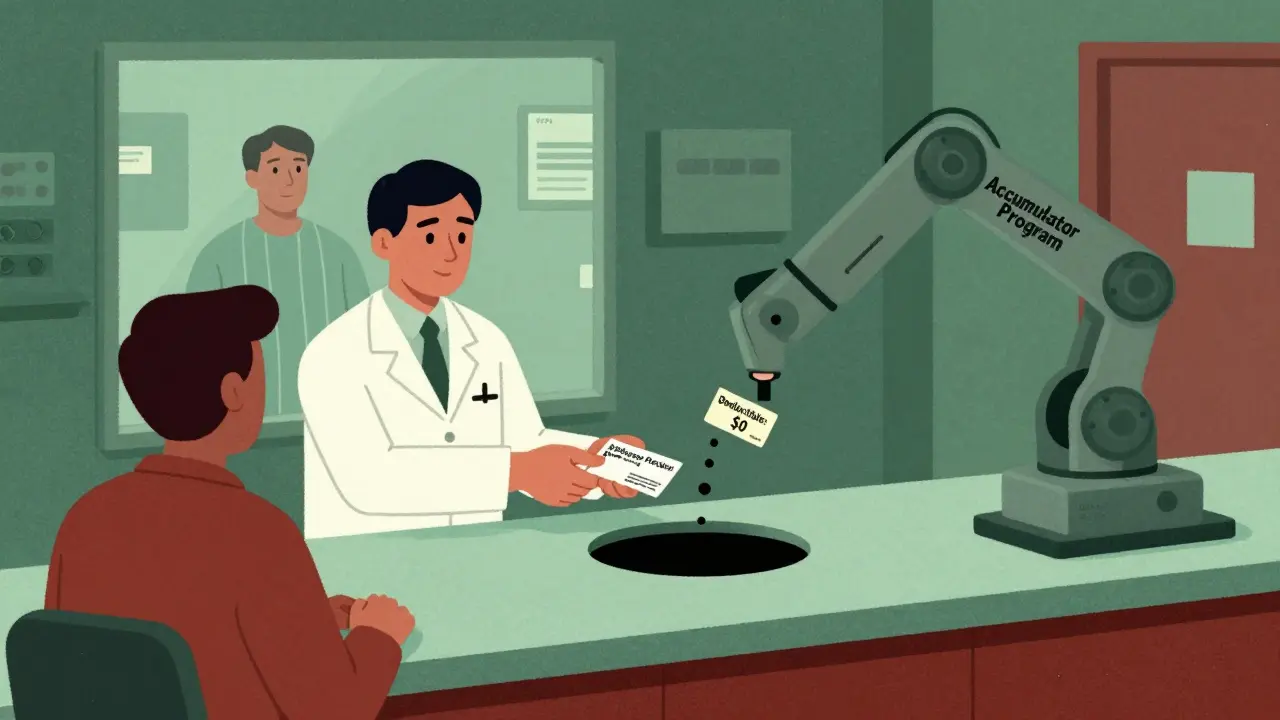
Who Gets Hurt the Most
It’s not just the money. It’s the people. A patient on Reddit shared: "I’ve been on my drug for three years. My copay was $10. Then the card expired. I had to stop. I was in the ER three weeks later because my symptoms came back hard. I didn’t know the card didn’t count toward my deductible. No one told me." That’s not rare. A 2021 study in the Journal of the American Medical Informatics Association found patients under accumulator programs were 23.4% more likely to stop taking their medication. For someone with MS, stopping means nerve damage. For someone with cancer, it means progression. For someone with diabetes, it means amputation risk. The American Medical Association called these programs "dangerous" and passed a resolution against them in 2022. The National Multiple Sclerosis Society says 72% of specialty drugs now come with copay cards-but only 32% of patients know if their plan has an accumulator program. That’s a terrifying gap.How to Protect Yourself
You can’t control what your insurer does. But you can control what you ask. Here’s what you need to do before you even pick up your first copay card:- Ask your pharmacy: "Does my insurance plan have a copay accumulator or maximizer program?" Don’t accept "I don’t know." Ask for the name of the insurer’s policy. Write it down.
- Call your insurer: Ask: "Do manufacturer copay assistance payments count toward my deductible and out-of-pocket maximum?" If they say "yes," get it in writing. If they say "no," ask how much of your deductible you’ve actually met so far.
- Check your card’s limits: Most cards have annual caps-$5,000 to $25,000. Know yours. Mark your calendar. When you’re at 80% used, start planning ahead.
- Ask your doctor: "Is there a lower-cost alternative?" Sometimes, a generic or older drug works just as well. If not, ask if the manufacturer offers patient assistance beyond the card.

What’s Changing in 2026
Good news: the rules are starting to shift. On January 1, 2026, the Department of Health and Human Services will require insurers to clearly disclose accumulator programs during enrollment. They must also send monthly statements showing your true progress toward your deductible-even if the card doesn’t count. That’s huge. For the first time, patients will know exactly where they stand. No more surprises. No more hidden cliffs. CVS Caremark has started rolling out "transparency dashboards" that show real-time deductible progress. But right now, only 28% of commercially insured Americans are covered by this. Don’t wait for it to come to you. Ask for it.What You Can Do Now
If you’re already caught in an accumulator trap:- Call your drug manufacturer. Many offer direct financial aid after the card expires.
- Ask your doctor about nonprofit foundations. Groups like the Patient Access Network Foundation (PAN) and the HealthWell Foundation give grants to patients who can’t afford meds.
- Check if your state has a copay accumulator ban. As of 2025, 11 states-including California, New York, and Illinois-have passed laws blocking these programs.
- Consider switching plans during open enrollment. If your next plan doesn’t have an accumulator, you’ll avoid the trap next year.
Final Thought: Your Care Isn’t a Game
Copay cards were never meant to be a trick. They were meant to save lives. But when insurers hide the rules, they turn a lifeline into a trap. You deserve to know the truth. You deserve to know how much you really owe. And you deserve to keep taking your medicine without fear of financial ruin. Don’t wait until your card runs out. Ask today. Document everything. Push for clarity. Because when your health is on the line, ignorance isn’t just inconvenient-it’s deadly.Can I use a copay card if I’m on Medicare or Medicaid?
No. Federal law prohibits drug manufacturers from providing copay assistance to patients enrolled in Medicare or Medicaid. These programs are designed only for people with private commercial insurance. If you’re on Medicare or Medicaid, you’ll need to explore other options like patient assistance programs from nonprofits or the drug manufacturer’s direct aid.
How do I know if my insurance has a copay accumulator program?
Call your insurance company directly and ask: "Do manufacturer copay assistance payments count toward my deductible and out-of-pocket maximum?" If they say "no," ask for a written copy of their policy. You can also ask your pharmacy-they’re required to check this before processing your card. If they don’t bring it up, insist on knowing.
What’s the difference between a copay accumulator and a copay maximizer?
A copay accumulator program ignores the manufacturer’s payment-it doesn’t count toward your deductible. A copay maximizer program sets your copay to exactly match the maximum amount the card will pay, so you pay $0-but you still don’t make progress toward your deductible. Both prevent you from reaching your out-of-pocket maximum, but maximizers make it look like you’re paying nothing, which can be more misleading.
What should I do when my copay card runs out?
Don’t wait until the last day. Start planning when you’ve used 80% of your card’s value. Contact the drug manufacturer-they often have ongoing patient assistance programs. Reach out to nonprofit foundations like PAN or HealthWell Foundation. Talk to your doctor about lower-cost alternatives. And if you’re eligible, apply for state or federal aid programs.
Are there any states that ban copay accumulator programs?
Yes. As of 2025, 11 states have passed laws banning copay accumulator and maximizer programs: California, Colorado, Connecticut, Illinois, Maine, Maryland, Nevada, New York, Oregon, Rhode Island, and Virginia. If you live in one of these states, your insurer must count manufacturer payments toward your deductible. Check your state’s health department website for details.
Can I switch insurance plans to avoid these programs?
Yes-if you’re eligible for open enrollment or a qualifying life event (like a job change or moving). When reviewing plans, ask about accumulator policies before choosing. Plans that don’t use these programs are becoming more common, especially after the 2026 federal disclosure rule. Don’t assume all plans are the same-ask before you sign up.





Kelly McRainey Moore
January 21, 2026 AT 01:56This hit me right in the feels. My mom’s on a $9k/month drug and her card just expired last month. She didn’t know it didn’t count toward her deductible until she got a bill for $14k. No one explained it. Not the pharmacy, not the doctor, not even the insurer. Just silence until the hammer dropped.
Dee Monroe
January 21, 2026 AT 05:02You know what’s wild? This whole system was built on the idea that people would be ‘responsible’ for their health-but no one ever told us the rules were rigged. Copay cards were supposed to be a bridge, not a trapdoor. And now we’re supposed to be grateful for the crumbs while the insurers count the cash? I’m not mad, I’m just disappointed. We’ve been gaslit by capitalism and told it’s healthcare.
It’s not about being rich or poor-it’s about being human. If your medicine stops working because of a loophole in a contract you never read, that’s not a market failure. That’s a moral one.
I used to think insurance was protection. Now I know it’s just a fancy word for ‘delayed financial collapse.’
And don’t even get me started on how they make it look like you’re saving money with maximizers. ‘Oh, you pay $0!’ Yeah, because you’re paying with your life. Your nerves. Your kidneys. Your future.
They’re not just hiding the math-they’re hiding the humanity. And that’s the real crime.
2026 can’t come soon enough. Until then, I’m printing out every email, saving every voicemail, and screaming into the void until someone listens. Because if I don’t, who will?
Alex Carletti Gouvea
January 22, 2026 AT 15:17Why are we even letting drug companies give out coupons? That’s just corporate welfare. If you can’t afford your meds, go on Medicaid. Stop relying on corporate charity.
Philip Williams
January 24, 2026 AT 00:42While the systemic flaws are undeniable, I believe the real solution lies in policy reform and patient advocacy. The accumulation and maximization practices are not merely administrative quirks-they are structural incentives misaligned with therapeutic outcomes. A 2024 JAMA study demonstrated that patients under these programs had a 41% higher rate of non-adherence, directly correlating with increased hospitalizations. This is not a cost-saving measure; it is a cost-shifting one, and it is ethically indefensible.
Furthermore, the transparency mandate set for January 2026 is a critical step forward. However, enforcement must be rigorous. Without penalties for non-compliance, insurers will continue to bury disclosures in fine print. We need legislative action, not just disclosure.
Patients must be empowered with standardized, plain-language disclosures at every touchpoint: enrollment, pharmacy pickup, and annual renewal. This is not a luxury-it is a right.
I urge every reader to contact their state representative and demand inclusion in the growing list of states banning these programs. Our health is not a spreadsheet.
Glenda Marínez Granados
January 25, 2026 AT 16:59So let me get this straight… we’re supposed to be grateful that a corporation gives us a coupon to buy our life-saving drug… but then the insurance company steals the value of that coupon and pretends we never used it? 🤡
Oh, and if we’re on Medicare? Too bad! The government can’t get free stuff, but Amazon can? 😂
Can we just rename this ‘The Great American Healthcare Scam’ and call it a day?
Yuri Hyuga
January 27, 2026 AT 08:30As someone living abroad, I’m horrified-but not surprised. The U.S. healthcare system operates like a high-stakes poker game where the cards are stacked, the dealers are insured, and the players are dying one deductible at a time.
I’ve seen systems where medicine is treated as a human right. Here, it’s treated like a subscription service you can cancel if you miss a payment. The fact that 72% of patients don’t even know if their plan has an accumulator program is criminal.
But here’s the hope: change is coming. The 2026 federal rule? That’s a start. But we need more. We need patient advocates in every clinic. We need pharmacists trained to scream from the rooftops if they spot an accumulator. We need media outlets to stop treating this as ‘health policy’ and start calling it what it is: systemic violence against the sick.
You’re not alone. I’m with you. Keep asking. Keep documenting. Keep fighting. The system wants you silent. Don’t let it win.
💙 #NoMoreHiddenCliffs
MARILYN ONEILL
January 27, 2026 AT 12:16Wow. So now we’re supposed to feel bad for people who can’t afford $7k drugs? Maybe they should’ve picked a cheaper disease. Like, I dunno, the common cold?
Also, why do these people always blame the insurance companies? Maybe they just need to get a job that pays more. Or stop being so dramatic.
Coral Bosley
January 27, 2026 AT 14:07I’ve been on this drug for five years. I cried the day my card expired. Not because I was mad. Because I was scared. I didn’t know what to do. I called my doctor. I called my insurer. I called the pharmacy. Everyone said ‘We’ll figure it out.’ But no one did.
My co-pay went from $10 to $1,200 overnight. I had to choose between my medication and my rent. I chose rent. Three weeks later, I was in the hospital with a flare-up that cost $42,000.
So yeah. I’m angry. Not because I’m entitled. Because I’m alive. And I’m tired of being treated like a statistic.
They say ‘ask your pharmacist.’ But what if your pharmacist is scared to tell you the truth? What if they’re told not to?
I’m not asking for a handout. I’m asking for a chance. That’s all.
Steve Hesketh
January 27, 2026 AT 18:47Brother, I feel you. I’m from Nigeria, and I’ve seen what happens when medicine is treated like a luxury. Here in the U.S., you’ve got the money-you’ve got the drugs-you’ve got the technology. But you’ve lost the heart.
Back home, we don’t have copay cards. We don’t have insurance. But we have community. We pool money. We share. We carry each other.
Here, you’re supposed to be ‘responsible’-but no one tells you the rules until you’re already bleeding out.
I’m not saying we copy Nigeria’s system. But we could learn from how we love each other when the system fails.
Call your rep. Write your story. Post it. Make noise. They can’t ignore a thousand voices. Not forever.
You are not alone. We see you. We hear you. And we’re with you.
Kevin Narvaes
January 29, 2026 AT 08:51so like… the card is a trap? wow. who knew. i thought it was just a discount. my bad. 🤡
also why is everyone so mad? just get a better job. or move to canada. or something.
Jarrod Flesch
January 30, 2026 AT 12:47I’ve been a pharmacist for 18 years. I’ve watched this play out in real time. The first time I saw a patient cry because their card expired and they didn’t know it didn’t count toward their deductible… I went home and cried too.
We’re not supposed to be the ones breaking this news. We’re supposed to be the ones helping. But the system doesn’t give us the tools. We’re not allowed to tell patients the full truth unless they ask-by name, in writing, in person.
And even then? We’re not always believed.
But I’ve started printing out the insurer’s policy documents and handing them to patients before they even pick up their card. I write ‘THIS DOES NOT COUNT TOWARD YOUR DEDUCTIBLE’ in big letters. I’ve had patients hug me. I’ve had them scream at me.
It’s not enough. But it’s something.
If you’re reading this and you’re on one of these plans? Don’t wait. Ask. Now. Write it down. Demand proof. You’re not paranoid. You’re prepared.
Barbara Mahone
January 30, 2026 AT 17:52The structural inequities exposed here are precisely why healthcare policy must be decoupled from employment. The fact that 67% of self-insured employer plans use these programs reveals a deeper truth: corporate interests dictate health outcomes. This is not a market failure-it is a design flaw.
Furthermore, the absence of standardized disclosure protocols across payers creates a labyrinthine system where patients are expected to navigate complexity without training, resources, or support. The 2026 federal mandate is necessary but insufficient without enforceable penalties and universal implementation.
Patients deserve clarity. Not just in language, but in access. Transparency must be proactive, not reactive.
Stephen Rock
February 1, 2026 AT 02:58stop crying about your pills
if you cant afford it dont take it
its not a right its a privilege
Glenda Marínez Granados
February 1, 2026 AT 08:07lol @7011. you're the reason this system is broken. 🤡