
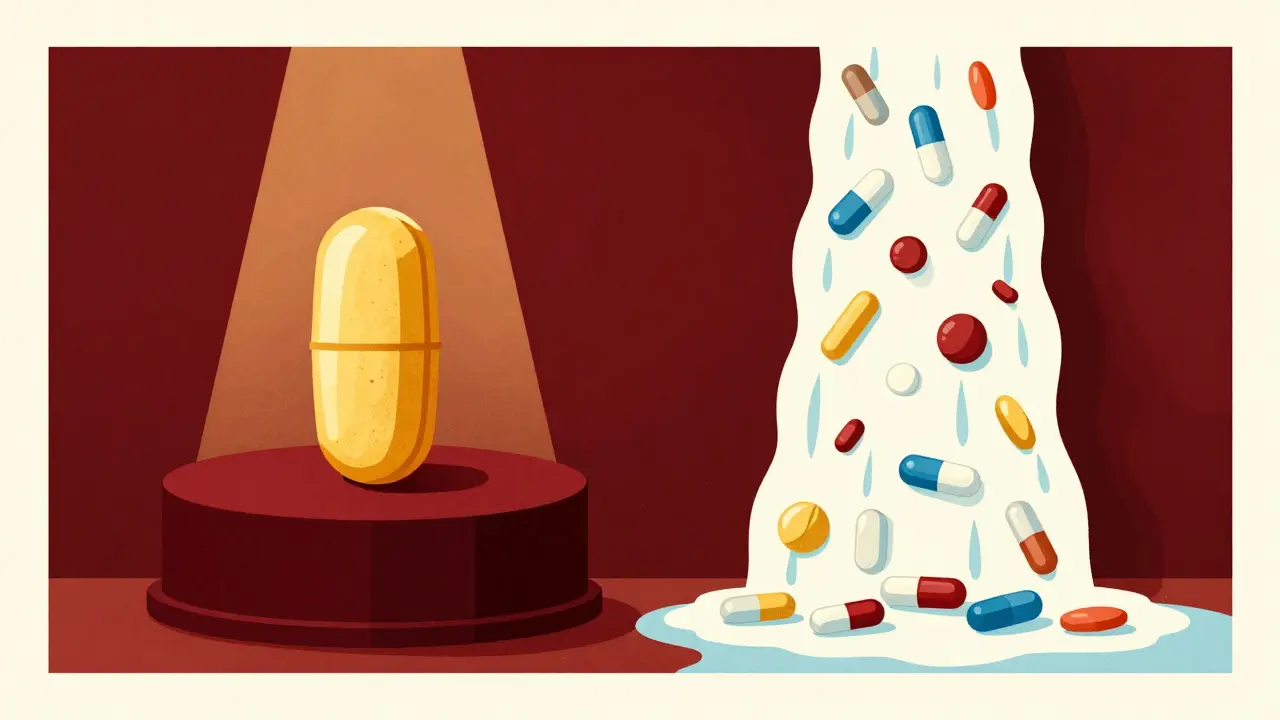
You’ve probably been at the pharmacy counter and noticed a sudden jump in price, or maybe your pharmacist told you they're switching the manufacturer of your regular medication. It's confusing. Why does one pill cost $130 while an almost identical one costs $15? The answer usually comes down to whether your medication is a single-source drug is a medication exclusively manufactured by one company with no generic equivalents available or a multi-source one. Understanding this distinction isn't just for pharmacists-it's the key to understanding why your insurance covers some drugs and not others, and why your out-of-pocket costs fluctuate.
The Basics: What Exactly are These Drugs?
To put it simply, a single-source drug is a medication that has one sole provider. This is usually because the drug is new and protected by a patent, or it's so complex to make that other companies can't replicate it. Because there is no competition, the manufacturer has a lot of power over the price. If you're taking a cutting-edge treatment for a rare disease or a new cancer therapy, you're likely dealing with a single-source medication.
On the flip side, multi-source drugs are medications available as both the original brand and generic equivalents from multiple different manufacturers. Think of common meds like Lisinopril used for high blood pressure. Once the original patent expires, other companies can apply to make their own versions. This competition is what drives prices down, making healthcare more affordable for millions of people.
| Feature | Single-Source | Multi-Source |
|---|---|---|
| Competition | None (Exclusive) | High (Multiple Generic Makers) |
| Typical Price | High / Premium | Lower / Budget-friendly |
| FDA Status | No therapeutic equivalence code | Listed in the Orange Book with codes |
| Common Use Case | New innovations, rare diseases | Established treatments (Diabetes, Hypertension) |
How Do We Know Generics Actually Work?
A common worry for patients is whether a cheaper multi-source drug is "less effective" than the brand name. To address this, the FDA (Food and Drug Administration) requires strict evidence of bioequivalence. This means the generic version must deliver the same amount of active ingredient into your bloodstream at the same rate as the original drug, usually within a tight window of 80% to 125% of the reference drug's performance.
If you want to verify a drug's status, the FDA maintains the Orange Book. This is essentially the gold standard directory for approved drug products. For multi-source drugs, the FDA assigns a "therapeutic equivalence" code. If a drug has an "A" rating, it means it's considered therapeutically equivalent to the brand name. Single-source drugs don't get these codes because there's nothing to compare them to-they are the only game in town.
The Money Trail: Why the Price Gap is So Huge
The pricing difference between these two categories is staggering. Data from the Kaiser Family Foundation shows that patients on single-source drugs pay an average of $587 per month, while those on multi-source drugs pay closer to $132. Why the gap? It comes down to market power.
For single-source drugs, the manufacturer sets the list price, and insurers pay rebates to manage costs. Interestingly, research from the USC Schaeffer Center found that for these drugs, rebates and list prices move almost dollar-for-dollar. This means if a manufacturer raises the price by $100, they might give a $100 rebate to the insurer, but you-the patient-might still be paying a percentage of that higher list price as a co-pay. It's a cycle that rarely results in lower costs for the person at the pharmacy window.
Multi-source drugs operate differently due to MAC pricing (Maximum Allowable Cost). PBMs (Pharmacy Benefit Managers) set a ceiling on what they will pay for a generic. Because multiple companies are fighting for the same business, the net price continues to drop. This is why about 86% of medications sold in the US are now generic or multi-source; they are simply more sustainable for the healthcare system.
The "Switching" Headache: When Your Generic Changes
Have you ever picked up a prescription and noticed the pill is a different color or shape than the last month? That's a classic multi-source experience. Your insurance company or PBM might change which generic manufacturer they contract with. Even though the active ingredient is the same and the FDA says they are bioequivalent, some patients report feeling a difference.
While the FDA maintains that these switches don't impact clinical outcomes, a small percentage of people are sensitive to "inactive ingredients" (fillers, dyes, or binders). If you feel your medication isn't working as well after a manufacturer switch, don't just stop taking it. Talk to your pharmacist. They can often see which manufacturer was used previously and help you request a specific one from your doctor if it's medically necessary.
Navigating Your Insurance and Formulary
If you are prescribed a single-source drug, be prepared for some hurdles. Insurance companies hate paying premium prices when a cheaper alternative exists. You'll likely encounter "step therapy," where the insurer requires you to try and fail on a multi-source generic before they agree to pay for the expensive single-source version.
To lower your costs, check your insurance "formulary" (the list of covered drugs). Single-source drugs are usually in a "Specialty Tier," meaning higher co-pays and stricter rules. If you're struggling with the cost of a single-source drug, ask your doctor if there's a multi-source alternative that's therapeutically equivalent. Often, a simple switch can save you hundreds of dollars a month without sacrificing your health.
Are generic multi-source drugs less effective than brand-name single-source drugs?
No. The FDA requires multi-source generics to prove bioequivalence, meaning they deliver the same active ingredient to the body at the same rate as the brand. While inactive ingredients like dyes may differ, the therapeutic effect is designed to be identical.
Why is my single-source medication so expensive?
Single-source drugs are typically newer medications protected by patents or have complex manufacturing processes. Without competition from other companies, the manufacturer can maintain a higher list price.
What should I do if my generic manufacturer changes and I feel different?
Contact your pharmacist immediately. They can identify the previous manufacturer. If you're experiencing new side effects or a lack of efficacy, your doctor can write a prescription for a "dispense as brand name only" or specify a particular manufacturer.
What is the Orange Book?
The Orange Book is an official FDA publication that lists approved drug products and identifies which generics are therapeutically equivalent to their brand-name counterparts using a coding system.
What is step therapy?
Step therapy is a cost-control process used by insurers where you must try a less expensive, multi-source drug before the insurance will cover a more expensive single-source medication.
Next Steps for Patients
If you're currently taking a high-cost medication, start by asking your pharmacist if a generic version exists. If it does, check if your insurance has a preferred generic on their list. For those on single-source drugs that are absolutely necessary, look into manufacturer patient assistance programs-these are often available for high-cost, patented drugs to help offset the lack of generic competition.


dwight koyner
April 5, 2026 AT 13:23It is imperative to understand that the bioequivalence standards mentioned are strictly enforced. For those struggling with cost, I highly recommend requesting a therapeutic alternative from your physician to transition from a specialty tier to a generic tier.
Ethan Davis
April 7, 2026 AT 13:21The FDA is just a mouthpiece for big pharma. You really think they care about bioequivalence? They just want us dependent on these synthetic chemicals while the companies rake in billions from the patents they manipulate.
jack hunter
April 9, 2026 AT 09:30imagine believing that a governmant agency actually protects you... its all just a simulation of care to keep the masses from realizing that health is just a commodity traded by ghouls who dont even know what a human is. the whole concpet of a patent is just a legal way to steal from the sick
Stephen Luce
April 9, 2026 AT 22:48I've definitely felt that difference after a manufacturer switch. It's so frustrating when you're just trying to stay stable and suddenly your meds feel 'off' even if the label says they're the same.
Christopher Cooper
April 10, 2026 AT 22:50This is a great breakdown of a very confusing system! It's fascinating how the interplay between PBMs and manufacturers creates such a volatile pricing environment for the end user. I wonder if there are ways to bypass the PBMs entirely in certain states?
Daniel Trezub
April 11, 2026 AT 19:52Actually, the Orange Book isn't as foolproof as this post makes it seem. Plenty of people experience significant side effect differences with 'A-rated' generics because the fillers aren't regulated the same way. It's not exactly a science, more like a guess with a stamp of approval.
Srikanth Makineni
April 13, 2026 AT 17:56big pharma greed plain and simple
Grace Lottering
April 15, 2026 AT 10:26Follow the money. The a-ratings are bribes. Total scam.
Michael Flückiger
April 15, 2026 AT 17:25Just keep pushing through!!! Always talk to your doctors!!! You have the power to advocate for your own health!!!!
Victoria Gregory
April 16, 2026 AT 09:51It's all about the energy of the healing process... maybe the generic just doesn't vibe with some people's systems?? ✨ I just try to stay positive and keep communicating with my care team!!! 🌸
Vivek Hattangadi
April 16, 2026 AT 16:49I totally agree with the point about manufacturer assistance programs! A lot of people don't even know those exist and they can literally be a lifesaver when the insurance denies a claim. Let's help each other find those resources!
Jamar Taylor
April 18, 2026 AT 03:22You got this everyone! Just take it one step at a time and don't let the insurance jargon discourage you! You're your own best advocate!
Rupert McKelvie
April 18, 2026 AT 15:44It is quite hopeful to see that 86% of meds are now generic. That's a massive win for accessibility over the long run.
Laurie Iten
April 20, 2026 AT 15:34the system is designed to prioritize profit over the human experience and the terminology is just a veil to hide that reality
Jitesh Mohun
April 21, 2026 AT 21:50stop complaining and just call the pharmacist if the pill looks different its not that hard to handle