
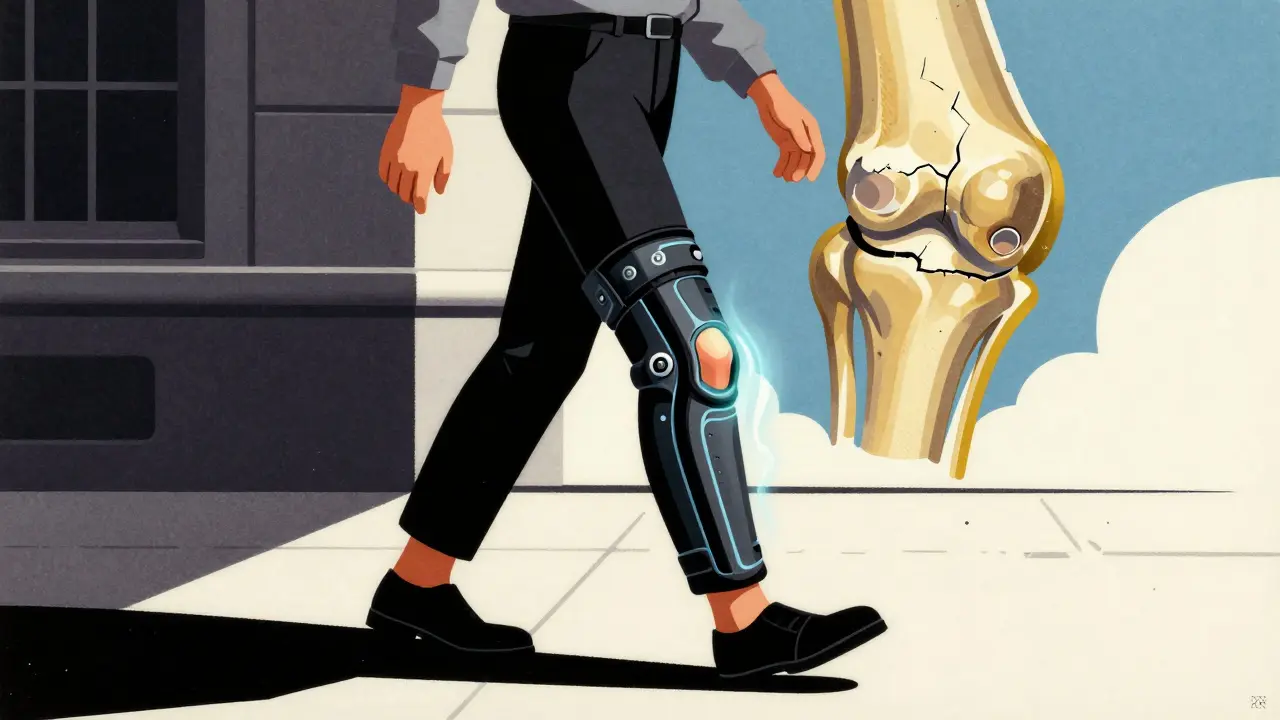
When your knee hurts just walking to the mailbox, you start wondering: what actually works? Knee osteoarthritis (OA) isn’t just about aging-it’s a real, measurable breakdown of cartilage, bone spurs, and inflammation that affects over 250 million people worldwide. For many, the pain isn’t constant, but it’s enough to make stairs, shopping, or even standing up from a chair feel like a battle. Surgery isn’t the only answer. In fact, most people can get real relief without ever stepping into an operating room. Three approaches-bracing, injections, and exercise-are backed by solid science, patient data, and decades of clinical use. But not all of them work the same way, and mixing them right makes all the difference.
Bracing: The Silent Support That Changes How Your Knee Moves
Think of a knee brace not as a crutch, but as a smart redirector. Unloader braces, the most effective type for knee OA, don’t just hold your knee still-they shift pressure away from the worn-out side of the joint. If your pain is mostly on the inner knee (medial compartment), which is true for 85% of cases, this brace gently pulls your leg into a better alignment. Studies show these braces reduce the force on that damaged area by 20-40%, and that small change leads to big results: a 30-45% drop in pain scores on the WOMAC scale, which measures pain, stiffness, and daily function.
They’re not magic. You need the right fit. A poorly fitted brace can rub, slip, or do nothing at all. That’s why seeing a certified orthotist matters. Most people need 2-3 weeks to get used to wearing it, especially during long walks. The cost? Between $300 and $1,200. Medicare covers about 80% if it’s FDA-approved and you have a doctor’s note, but you’ll still pay the annual deductible. On Amazon, top-rated braces get 4.1 stars, with 82% of 5-star reviews saying, “I can walk without limping now.” But 47% of 1-star reviews complain about skin irritation or feeling like a robot. The key? Wear it during activity-walking, standing, climbing stairs-not all day. And don’t skip the fitting.
Injections: Fast Relief, But Not a Long-Term Fix
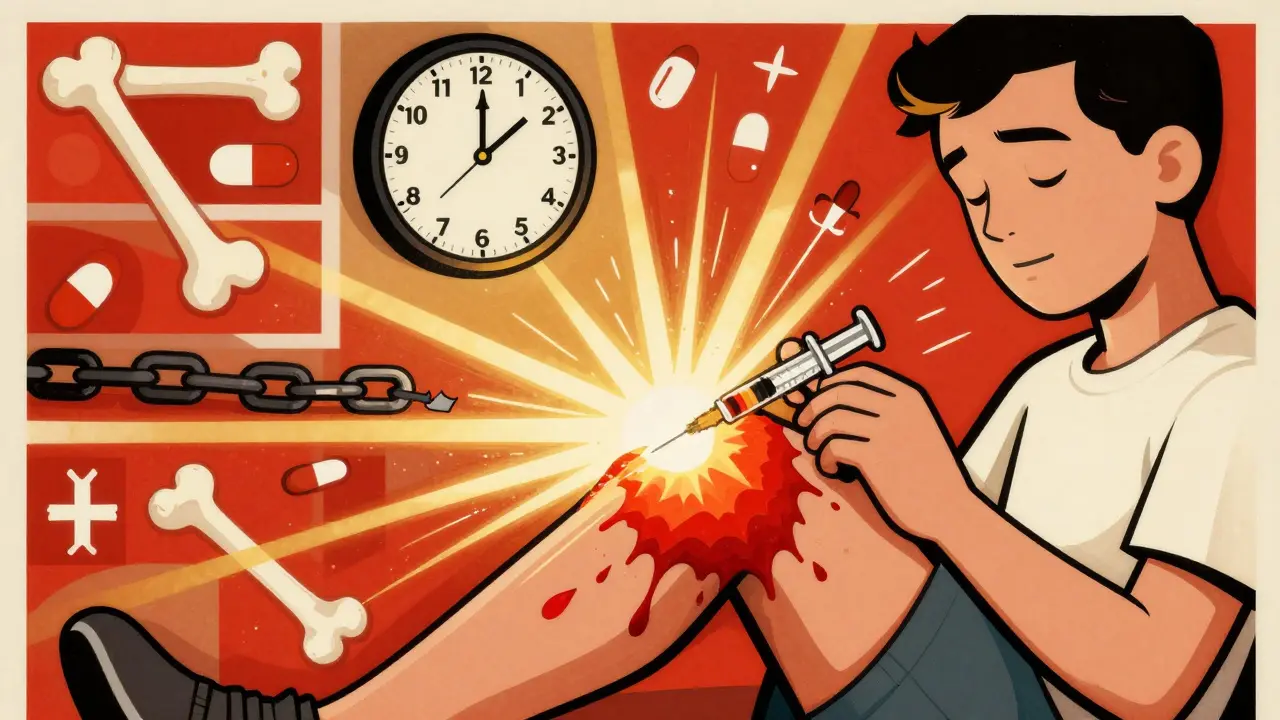
If you need pain relief fast-say, before a family trip or to get through a flare-up-injections are hard to beat. Corticosteroids, the most common, can knock down inflammation in days. You’ll feel better in 1-3 days, and the relief lasts 4-12 weeks. A single shot costs $50-$150, and most insurance covers it. But there’s a catch: repeated use may hurt your cartilage over time. The AAOS recommends no more than 3-4 injections per year.
Hyaluronic acid (HA) injections are another option. They’re like adding lubricant to a rusty hinge. A series of 3-5 shots, given weekly, can smooth movement and reduce pain for up to 22 weeks with the new Gel-Syn 3 formula. But it’s expensive: $500-$1,200 per series. And while some patients swear by it, others feel no difference. A 2023 review of 552 patients found HA reduced pain by 35.2mm on the VAS scale at 4 weeks-better than exercise alone, but still not permanent.
PRP (platelet-rich plasma) and botulinum toxin are newer, pricier options-$500-$2,000 per injection-and not yet proven to be better than placebos in large studies. The biggest downside? The injection itself hurts. Over half of negative reviews on Healthgrades mention “painful procedure.” And while 65% of users report satisfaction, 32% say the pain comes back worse after the initial relief. Injections are a tool for short-term rescue, not a cure. Relying on them without movement? That’s how you lose muscle and weaken your knee over time.
Exercise: The Only Intervention That Builds Real Change
This is where most people get it wrong. They think exercise means running or squatting. It doesn’t. For knee OA, the goal isn’t to stress the joint-it’s to strengthen the muscles around it. Strong quads, hamstrings, and hips take pressure off the knee. Water-based exercise-like walking in a pool or water aerobics-reduces pain by 28.7% on the Visual Analog Scale. Land-based exercises like seated leg lifts, step-ups, and mini-squats cut pain by 22.3%. Both require 2-3 sessions a week, 45-60 minutes each. The difference? Water is kinder on the joint. Land-based builds strength faster.
Stretching matters too. Daily hamstring and calf stretches improve your knee’s range of motion by an average of 8.2 degrees after 6-8 weeks. That might not sound like much, but it means you can sit cross-legged, get out of a car, or bend down to tie your shoes without wincing.
Here’s the hard truth: 67% of people with knee OA try exercise. Only 28% stick with it past six months. Why? It’s slow. You won’t feel better after one session. It takes 12-16 weeks to see real gains. And it’s easy to quit when you’re in pain. That’s why supervised sessions with a physical therapist for the first 4-6 weeks boost success rates by 60%. Look for programs based on OARSI guidelines-they’re proven. And don’t underestimate the power of consistency. People who stick with it don’t just have less knee pain-they report less pain in their hips, back, and even their shoulders. Strength builds everywhere.
What Works Best Together
There’s no single hero here. The real breakthrough isn’t one treatment-it’s the combo.
Bracing gives you immediate support so you can move without fear. Injections give you relief during flare-ups so you don’t give up on movement. Exercise builds the long-term strength that keeps pain from coming back.
Dr. Tuhina Neogi, a leading OA researcher, puts it bluntly: “Combination therapy-exercise plus bracing plus periodic injections for flare-ups-is the most comprehensive approach.” That’s the sweet spot. Use the brace when you’re out walking. Get a corticosteroid shot if your pain spikes after a bad day. And stick with your exercise routine even when you’re feeling okay. The data is clear: at 12 months, people who did all three improved 32.5% in function. Those who only did injections? Just 18.7%.
And here’s something surprising: exercise has the lowest risk and the highest payoff over time. It costs almost nothing. No prescriptions. No insurance battles. Just your time. The dropout rate? 25-35%. But for bracing? Only 5-10%. Injections? Just 2-5%. That’s why the best plan starts with exercise, adds bracing for daily support, and uses injections sparingly-like a fire extinguisher, not a daily shower.

What to Avoid
Don’t skip the basics. Weight management isn’t just a footnote-it’s part of the treatment. Losing 5% of your body weight reduces knee load by 20%. That’s like removing a backpack full of bricks every step you take.
Avoid TENS units. The AAOS says there’s “limited evidence” they help. Don’t waste money on fancy knee sleeves that claim to “stimulate healing.” Most are just compression wraps with no biomechanical benefit.
And don’t believe the myth that “resting your knee is better.” Inactivity leads to muscle loss, which makes your knee less stable-and more painful. Movement is medicine.
Real Talk: What Patients Are Saying
On Reddit, one user wrote: “I tried the brace first. It felt weird. Then I started pool workouts. After 3 months, I walked 5K without pain. I only get injections now if I twist my knee badly.”
Another on Healthgrades: “The cortisone shot helped me get through Christmas. Then I started physical therapy. Now I’m off the shots and still pain-free.”
These aren’t outliers. They’re the pattern. The people who succeed aren’t the ones who find the magic bullet. They’re the ones who build a routine. A brace for activity. Exercise for strength. Injections only when needed.
The future is personalized. Smart braces with sensors are already here, giving real-time feedback on how you walk. AI-driven exercise plans are coming. But right now, the best tool you have is knowledge-and consistency.
Can I use a knee brace and get injections at the same time?
Yes, and it’s often recommended. A brace helps reduce joint stress during daily movement, while injections manage flare-ups. Using both means you’re less likely to overuse injections or skip exercise because of pain. Many physical therapists suggest wearing the brace during the day and getting injections only when pain spikes despite consistent movement.
How long does it take for exercise to start working for knee OA?
You won’t feel better after one session. Most studies show noticeable pain reduction after 6-8 weeks of consistent exercise (2-3 times per week). Maximum benefit-like improved strength and mobility-typically takes 12-16 weeks. The key is sticking with it, even if progress feels slow. Muscle adaptation takes time, but once it happens, the results last.
Are knee injections worth it if they only last a few weeks?
Yes-if they help you get back to movement. Injections aren’t meant to be a permanent fix. Their real value is giving you a window of pain relief so you can do the exercises that build long-term strength. If you skip exercise after an injection, you’re missing the point. Use the relief to move more, not less. Many patients find that after 2-3 injections spaced over a year, they no longer need them because their muscles have taken over the job of stabilizing the knee.
Do I need a prescription for a knee brace?
For insurance coverage, yes. Medicare and most private insurers require a doctor’s prescription and a fitting by a certified orthotist. Even if you buy one online, the right brace for your knee type (medial vs. lateral OA) needs professional selection. A brace that doesn’t match your joint alignment can make pain worse. Don’t guess-get fitted.
Can exercise make knee OA worse?
Only if you do high-impact activities like running, jumping, or deep squats with poor form. Low-impact, controlled movement-like cycling, swimming, leg lifts, and step-ups-actually protects the joint by strengthening the muscles that support it. The key is avoiding pain during and after exercise. If your pain increases by more than 2 points on a 10-point scale after a session, you’re doing too much. Adjust intensity, not frequency.




Sabrina Sanches
March 13, 2026 AT 00:00And yes, the brace felt weird at first. Like wearing a robot exoskeleton. But now? I forget it's on. That's the win.
Rosemary Chude-Sokei
March 14, 2026 AT 05:35Noluthando Devour Mamabolo
March 14, 2026 AT 07:57Leah Dobbin
March 15, 2026 AT 04:35Ali Hughey
March 17, 2026 AT 01:22Alex MC
March 18, 2026 AT 02:45rakesh sabharwal
March 18, 2026 AT 04:12Aaron Leib
March 18, 2026 AT 11:54Dylan Patrick
March 18, 2026 AT 14:22Kathy Leslie
March 19, 2026 AT 22:45Amisha Patel
March 20, 2026 AT 04:19Elsa Rodriguez
March 20, 2026 AT 20:07Serena Petrie
March 21, 2026 AT 06:15