
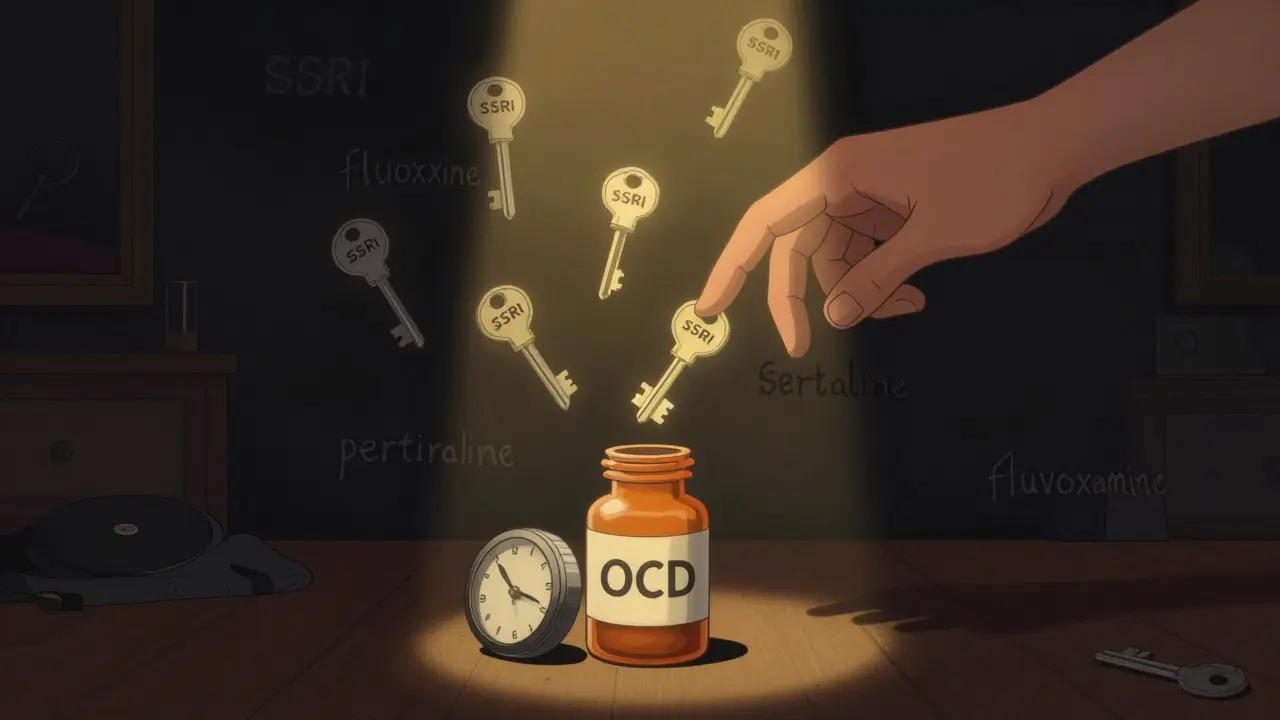
When someone is struggling with obsessive-compulsive disorder (OCD), finding the right medication can feel like searching for a key in a dark room. It’s not just about taking a pill-it’s about finding the right one, at the right dose, with the least side effects. For many, this journey starts with two main classes of medication: SSRIs and clomipramine. Both work on serotonin in the brain, but they’re not the same. One is usually tried first. The other is saved for when things don’t work. And the dose? It’s not what you’d use for depression. That’s where most people get stuck.
Why SSRIs Are the First Choice
SSRIs-selective serotonin reuptake inhibitors-are the go-to starting point for OCD treatment. Why? Because they work, and they’re easier to live with. Medications like fluoxetine (Prozac), sertraline (Zoloft), paroxetine (Paxil), and fluvoxamine (Luvox) are FDA-approved for OCD. But here’s the catch: the doses needed for OCD are much higher than what’s used for depression. A typical starting dose for depression might be 20 mg of fluoxetine. For OCD, you’re looking at 40-60 mg, sometimes even higher. And it takes time. Most people don’t feel better until they’ve been on a full therapeutic dose for 8 to 12 weeks. That’s longer than most people expect.
Doctors usually start low. For sertraline, that’s 25 mg a day. For fluvoxamine, it’s 25 or 50 mg. Then, every 5 to 7 days, the dose goes up by 25-50 mg. The goal? To reach 200-300 mg/day for sertraline, or 200-300 mg/day for fluvoxamine. Paroxetine often ends up at 40-60 mg/day. If you stop because you don’t feel better after six weeks, you’re giving up too soon. Studies show 70% of people who stick with it for 12 weeks see improvement.
Side effects? They’re real but usually mild. Nausea, trouble sleeping, or feeling jittery in the first few weeks are common. About 15-18% of people stop because of side effects. That’s lower than clomipramine. And unlike older meds, SSRIs don’t cause major heart risks or dry mouth so severe you need to drink water every 10 minutes.
Clomipramine: The OG OCD Med
Clomipramine (Anafranil) was the first drug ever approved by the FDA specifically for OCD-in 1989. It’s a tricyclic antidepressant, not an SSRI. And while it’s older, it’s not outdated. In fact, for some people, it’s the only thing that works. Studies show clomipramine can improve OCD symptoms by 37% in kids and teens, outperforming some SSRIs. In adults, it’s about equal to SSRIs in effectiveness.
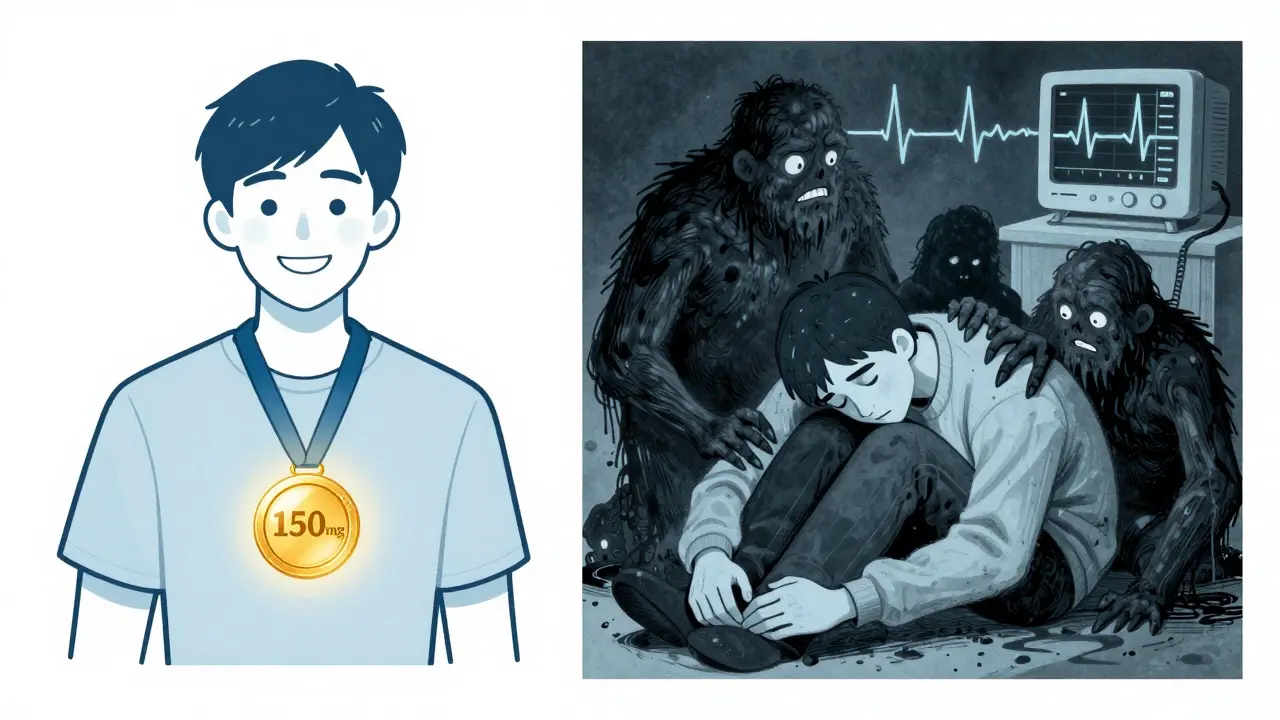
But here’s the trade-off: side effects. Clomipramine blocks more than just serotonin. It hits acetylcholine, histamine, and norepinephrine too. That means dry mouth, constipation, weight gain, drowsiness, and blurry vision. For some, it’s overwhelming. One Reddit user said: “I got 175 mg working-finally stopped my checking rituals-but I was sleeping 12 hours a day and couldn’t focus at work.”
Dosing clomipramine isn’t simple. You don’t just start at 100 mg. The standard protocol begins at 25 mg a day. Then, every 4 to 7 days, you add another 25 mg. Most people need at least 100 mg to see results. The sweet spot? 150-250 mg/day. But the max is 250 mg. For kids aged 10+, it’s 1-3 mg per kg of body weight, capped at 200-250 mg. Elderly patients? Start at 10 mg. Slowly. Their bodies process it differently.
Because of its effect on the heart, doctors monitor QTc intervals on ECGs if the dose goes above 150 mg. Blood levels matter too. People who respond well to clomipramine usually have plasma levels between 220-350 ng/mL for clomipramine itself, and around 379 ng/mL for its metabolite, desmethylclomipramine. That’s why some specialists do therapeutic drug monitoring-especially if someone isn’t improving.
Comparing the Two: What Works Best?
Is clomipramine better than SSRIs? The answer depends on who you are.
- For adults: Studies show they’re about equal. If an SSRI fails, clomipramine is often next. But if you’re starting fresh, SSRIs win because of fewer side effects.
- For kids and teens: Clomipramine shows stronger results in some trials. But because of side effects, SSRIs are still first-line. Only if two SSRIs don’t work do doctors consider clomipramine.
- For contamination OCD: Clomipramine at 150-250 mg/day seems especially effective for cleaning and washing rituals.
Here’s a real-world snapshot: In a survey of 1,247 people on OCD-UK, 62% found SSRIs easier to tolerate. On Drugs.com, clomipramine got a 7.2/10 for effectiveness-but only 5.1/10 for satisfaction because of side effects. SSRIs? 6.8/10 effectiveness, 6.2/10 satisfaction. The gap? Side effects.
How Dosing Really Works in Practice
It’s not just about the number on the bottle. It’s about how you get there.
For SSRIs:
- Start at 25 mg/day (sertraline) or 25-50 mg/day (fluvoxamine).
- Increase by 25-50 mg every 5-7 days.
- Wait 4-6 weeks before deciding if it’s working.
- Goal: 200-300 mg/day for sertraline or fluvoxamine; 40-60 mg/day for paroxetine or fluoxetine.
For clomipramine:
- Start at 25 mg/day.
- Increase by 25 mg every 4-7 days.
- Most need 10-14 weeks to reach 100-250 mg/day.
- Take it at bedtime-it makes you sleepy.
- Split higher doses: 75% at night, 25% in the morning if needed.
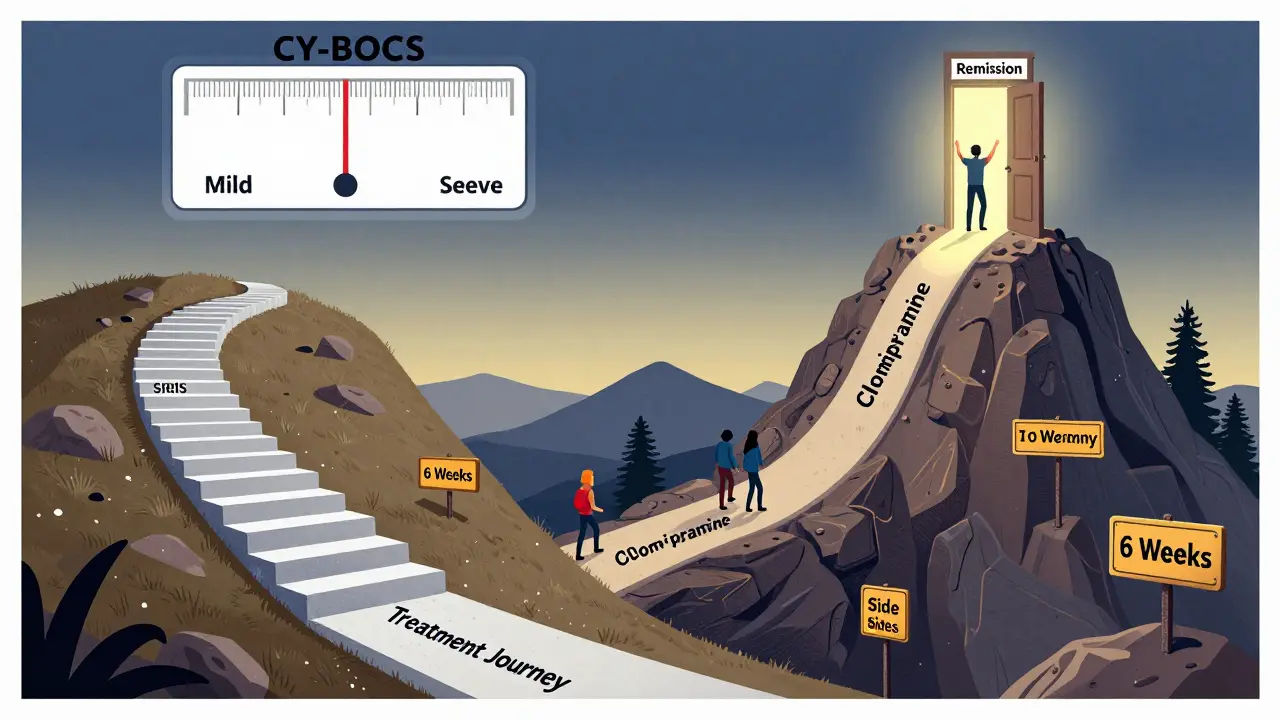
And don’t skip monitoring. Blood tests for liver function. ECGs if on high doses. And the CY-BOCS scale-used by therapists to measure symptom severity-is tracked every 2-4 weeks. A 25-35% drop in score is considered a good response.
When SSRIs Don’t Work: What’s Next?
The American Psychiatric Association says: try two adequate SSRI trials before even thinking about clomipramine. That means 12 weeks on each, with 6 weeks at the maximum tolerated dose. If you quit after 4 weeks because you felt worse? You’re not alone. About 37% of people experience a spike in anxiety in the first week or two. But 89% of them improve if they stick with it.
For those who don’t respond, options include:
- Switching to clomipramine.
- Adding low-dose clomipramine (25-75 mg/day) to an SSRI. This is called augmentation. Since 2020, this combo has grown 15% a year. Studies show 35-40% of partial responders improve with it.
- Trying newer options in development. In March 2023, the FDA gave Breakthrough Therapy status to SEP-363856, a new serotonin modulator. Early trials showed 45% response in treatment-resistant cases.
- Psilocybin-assisted therapy is now in phase 3 trials. Early results show 60% remission at 6 months-compared to 35% with SSRIs alone.
Real Numbers, Real Life
Let’s break it down:
- 1.2% of U.S. adults have OCD-that’s 3.1 million people.
- 85% of first prescriptions are SSRIs. Sertraline is #1 (32%), then fluvoxamine (28%).
- Clomipramine is only 8% of first prescriptions-but jumps to 22% after two failed SSRI trials.
- Generic SSRIs cost $350-$500 a year. Branded clomipramine? $800-$1,200.
- 43% of people who tried clomipramine quit because of side effects. Only 18% quit SSRIs.
One patient said: “I tried four SSRIs. Nothing. Then clomipramine at 200 mg. It stopped my rituals. But I gained 20 pounds and felt like a zombie. I switched back to sertraline at 225 mg. It’s not perfect-but I can function.”
What’s Changing in 2026?
The field is moving fast. Transdermal clomipramine patches are in phase 2 trials. They deliver the same dose with 40% fewer side effects. That could change everything. Meanwhile, the market expects SSRIs to hold 75-80% of prescriptions through 2028. Clomipramine’s future? Not as a first choice-but as a targeted tool for severe cases, or as a low-dose add-on.
The message? You don’t have to suffer. There’s a path. But it’s not quick. It’s not one-size-fits-all. And it’s not about giving up after a few weeks. It’s about working with your doctor, tracking your symptoms, and being patient. Medication doesn’t fix OCD overnight. But for many, it creates the space needed for therapy-and life-to change.
Weston Potgieter
March 7, 2026 AT 10:28William Minks
March 7, 2026 AT 18:17Susan Purney Mark
March 8, 2026 AT 05:50Amina Aminkhuslen
March 8, 2026 AT 17:37amber carrillo
March 10, 2026 AT 01:05Tim Hnatko
March 11, 2026 AT 17:35Aaron Pace
March 12, 2026 AT 07:48Joey Pearson
March 14, 2026 AT 00:27Roland Silber
March 14, 2026 AT 08:01