
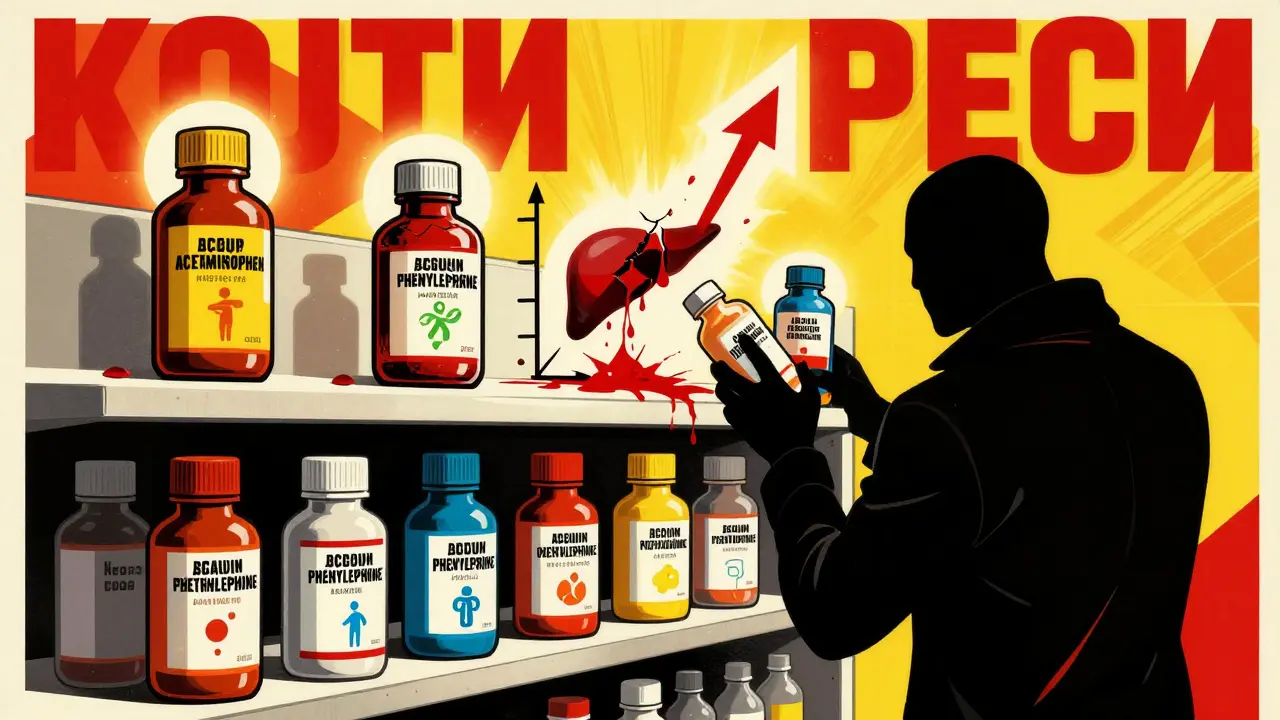
Acetaminophen Dose Calculator
Calculate Your Daily Acetaminophen Intake
Acetaminophen is in over 600 OTC products. The safe limit is 4,000 mg per day. Exceeding this can cause serious liver damage. This calculator helps you stay safe.
Current Total
0 mgSafety Information
Warning: Do not exceed 4,000 mg of acetaminophen in 24 hours. If you're taking other medications containing acetaminophen (like some cold or allergy medicines), add those amounts to your total.
Signs of overdose: Nausea, vomiting, loss of appetite, sweating, and pain in the upper abdomen. If you suspect overdose, call poison control at 1-800-222-1222 immediately.
Every winter, millions of people reach for a bottle of cold or allergy medicine thinking they’re doing the right thing. They want to feel better fast-no doctor’s visit, no prescription. But what they don’t realize is that the very medicine meant to help them might be quietly putting them at risk. Combination cold and allergy medications are everywhere: on pharmacy shelves, in grocery store aisles, in medicine cabinets. They promise relief from runny nose, cough, fever, and congestion-all in one pill. But behind that convenience is a hidden danger: accidental overdose, dangerous interactions, and side effects that can land you in the ER.
What’s Really in Your Cold Medicine?
Most over-the-counter cold and allergy medicines don’t contain just one active ingredient. They’re mixtures-often two, three, or even four drugs packed into a single tablet or liquid. The most common ones include:- Acetaminophen (also labeled as APAP): for fever and pain
- Pseudoephedrine or phenylephrine: nasal decongestants
- Dextromethorphan (often labeled DM): cough suppressant
- Chlorpheniramine or diphenhydramine: antihistamines for sneezing and itchy eyes
The Hidden Interaction: Acetaminophen + Phenylephrine
One of the most dangerous but least known interactions happens between acetaminophen and phenylephrine. You’ll find this combo in products like Tylenol Sinus, Sudafed PE, and many store-brand cold remedies. On paper, both seem harmless. But research published in the Journal of Clinical Pharmacology in 2014 showed something surprising: when you take acetaminophen with phenylephrine, your body absorbs the decongestant much more strongly. Blood levels of phenylephrine can jump up to four times higher than if you took it alone. What does that mean? Higher blood pressure. Faster heartbeat. Dizziness. Tremors. In people with existing heart conditions or high blood pressure, this can be dangerous. New Zealand studies found that phenylephrine-acetaminophen combinations caused 4.1 times more hypertension-related side effects than acetaminophen alone. And yet, most people don’t know this. Why? Because the label doesn’t scream warning-it just lists ingredients in tiny print.Pseudoephedrine vs. Phenylephrine: Which Is Actually Better?
If you’ve ever wondered why some cold medicines are kept behind the pharmacy counter while others sit on open shelves, it’s because of pseudoephedrine. It’s more effective. Studies show it reduces nasal congestion by about 65%. Phenylephrine? Around 45%. And the FDA is currently reviewing whether phenylephrine even works at all at standard doses. A 2022 petition from researchers at the University of Florida and Rutgers analyzed 11 clinical trials and found phenylephrine performed no better than a placebo. So why is it still everywhere? Because pseudoephedrine is harder to get. It’s regulated due to its use in making methamphetamine. That’s why manufacturers switched to phenylephrine-it’s easier to sell. But here’s the catch: phenylephrine isn’t safer. It just looks safer on the shelf. And when paired with acetaminophen, it becomes riskier.Dextromethorphan and Antidepressants: A Silent Danger
Dextromethorphan (DM) is the cough suppressant in Robitussin, DayQuil, and NyQuil. It’s fine for most people. But if you’re taking an SSRI like sertraline (Zoloft), fluoxetine (Prozac), or an SNRI like venlafaxine (Effexor), you’re playing with fire. Combining DM with these antidepressants can trigger serotonin syndrome-a rare but life-threatening condition where your body has too much serotonin. Symptoms include high fever, rapid heartbeat, confusion, muscle rigidity, and seizures. A 2017 study in the Journal of Clinical Psychiatry found that this combination increases serotonin syndrome risk by 300%. Yet, most people don’t connect their cold medicine to their antidepressant. They think, “I’m just taking something for my cough.” But the interaction doesn’t care about your intention. It only cares about the chemistry.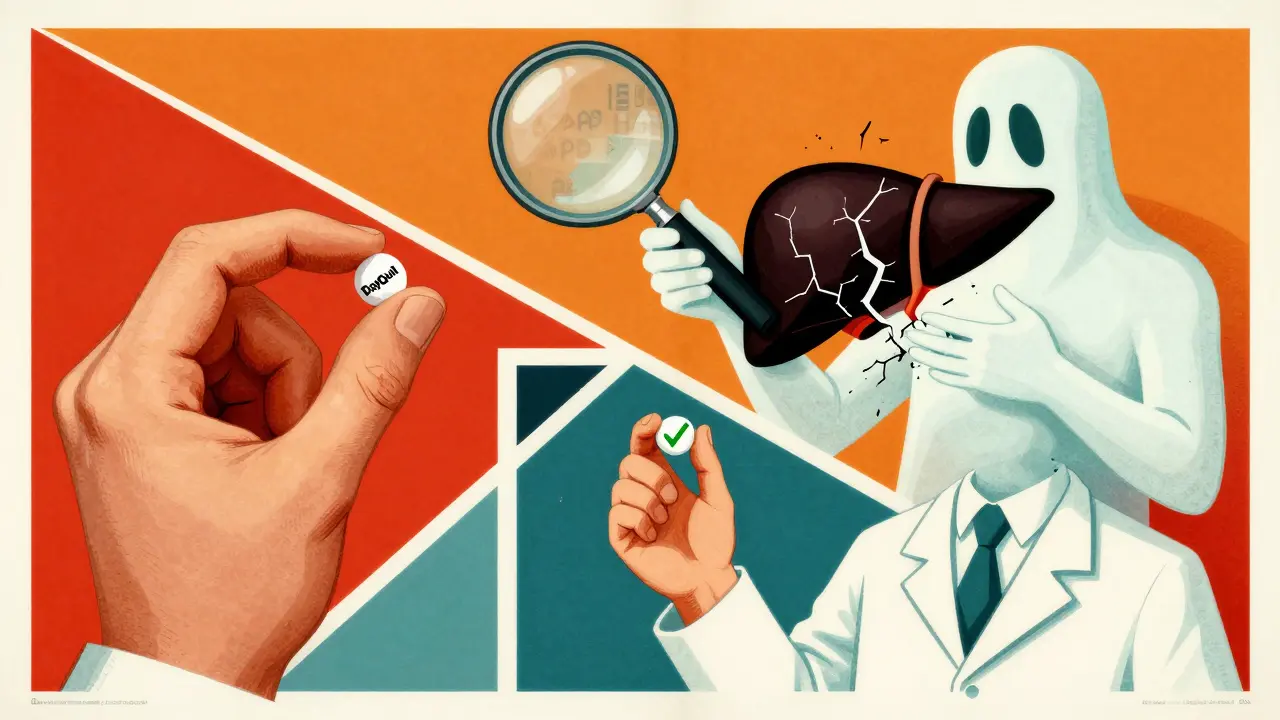
Why You’re Accidentally Overdosing
The biggest reason people end up with dangerous drug interactions? They don’t read the labels. A 2022 Consumer Reports survey found that 41% of people don’t check all the ingredients when buying cold medicine. And it’s not just about acetaminophen. Many don’t know that “APAP” means acetaminophen. Or that “DM” is dextromethorphan. Or that “PE” stands for phenylephrine. Here’s what happens in real life: someone takes DayQuil for a cough and runny nose. Later, they get a headache and grab a generic pain reliever. They don’t realize that the pain reliever also contains acetaminophen. Two doses. Four hours apart. Total: 2,000 mg. Then they take another dose the next day. By day three, they’re at 6,000 mg-1,500 mg over the safe limit. The CDC estimates 6.7 million Americans accidentally overdose on acetaminophen every year-mostly because of combination products.What to Do Instead
You don’t need a combination product to feel better. In fact, you’re often safer with single-ingredient medicines.- If you have a fever or pain, take acetaminophen or ibuprofen alone.
- If you’re congested, try pseudoephedrine (behind the counter) instead of phenylephrine.
- If you have a cough, use dextromethorphan only if you’re not on antidepressants.
- If you have allergies, use a non-drowsy antihistamine like loratadine or cetirizine.
How to Check for Interactions Before You Buy
Follow this simple 3-step system every time you pick up an OTC medicine:- Read the Drug Facts label-not the brand name. Look for active ingredients. If you see acetaminophen, APAP, or any other ingredient you’re already taking, stop.
- Compare with your other meds. Do you take a daily pain reliever? An antidepressant? A blood pressure pill? Check if any ingredients overlap.
- Ask a pharmacist. Pharmacists are trained to catch these interactions. Don’t be shy. Take the bottle with you. They’ve seen this a thousand times.
Who’s at Highest Risk?
Some people are more vulnerable than others:- Older adults: Often take multiple medications. Slower metabolism means drugs stick around longer.
- People with high blood pressure or heart disease: Decongestants can spike blood pressure dangerously.
- Those on antidepressants: Especially SSRIs and SNRIs-dextromethorphan is a red flag.
- People with liver disease: Even small extra doses of acetaminophen can be toxic.
What’s Changing in 2026?
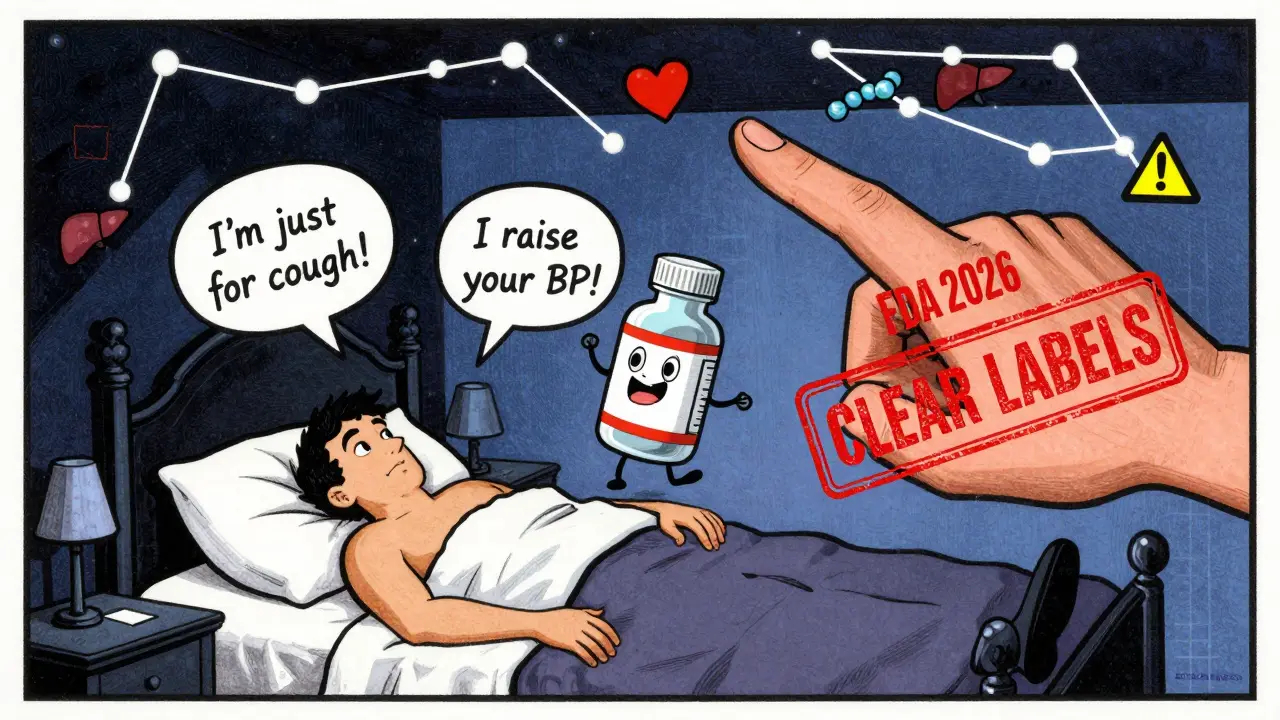
The FDA is finally stepping in. Starting in December 2024, all new combination cold and allergy products must have clearer labels: bigger fonts, high-contrast colors, and bold warnings about duplicate ingredients. The agency is also reviewing phenylephrine’s effectiveness. If the FDA decides it doesn’t work at standard doses, many popular products may be reformulated or pulled from shelves. Manufacturers are already reacting. Johnson & Johnson (Tylenol) and Procter & Gamble (Vicks) have filed patents for new formulas using caffeine and guaifenesin instead of phenylephrine. This could mean safer, more effective cold meds in the near future. But until then, you need to be your own protector.Final Rule: Less Is More
The idea that “more ingredients = better relief” is a myth. In reality, more ingredients = more risk. You don’t need to treat every symptom at once. If you only have a cough, take a cough suppressant. If you only have a stuffy nose, use a decongestant. If you’re not sure, wait. Let your body heal. Drink water. Rest. Sometimes, the best medicine is no medicine at all.Can I take allergy medicine and cold medicine together?
You can, but only if you check the ingredients. Many allergy medicines already contain decongestants or pain relievers. If you add a cold medicine with the same ingredients, you risk overdose. Always compare active ingredients before combining them. If in doubt, use single-ingredient options and space them out.
Is it safe to take cold medicine with high blood pressure?
Avoid any cold medicine with pseudoephedrine or phenylephrine. Both can raise blood pressure. Instead, use a saline nasal spray, a humidifier, or a non-decongestant option like guaifenesin for congestion. Always check with your doctor before taking any OTC medicine if you have hypertension.
What’s the safest OTC cold medicine?
The safest option is a single-ingredient medicine that targets only the symptom you have. For example: acetaminophen for fever, loratadine for allergies, or guaifenesin for chest congestion. Avoid anything labeled “multi-symptom,” “full relief,” or “all-in-one.” These are the most likely to cause interactions.
Can I take cold medicine if I’m on antidepressants?
Avoid any cold medicine containing dextromethorphan (DM) if you’re on an SSRI or SNRI. This combo can cause serotonin syndrome. Use non-medication options like honey for cough, or saline rinses for congestion. Always check with your doctor or pharmacist before taking any new OTC drug.
How do I know if I’ve taken too much acetaminophen?
Early signs include nausea, vomiting, loss of appetite, and sweating. But liver damage can happen without symptoms at first. If you’ve taken more than 4,000 mg in 24 hours-or if you’re unsure-call poison control at 1-800-222-1222 immediately. Don’t wait for symptoms. Acetaminophen overdose is treatable if caught early.
If you’ve ever felt dizzy, had a racing heart, or gotten sick after taking two cold medicines at once-you’re not alone. Millions have. But you don’t have to keep making the same mistake. Read the label. Know your ingredients. Ask for help. Your body will thank you.




bob bob
January 3, 2026 AT 23:19Man, I used to grab those multi-symptom bottles like they were candy. Then I ended up in the ER with a liver scare after mixing Tylenol and DayQuil. Didn’t even know APAP was acetaminophen. Learned the hard way. Now I read labels like they’re contracts. Seriously, if you don’t, you’re playing Russian roulette with your liver.
Terri Gladden
January 4, 2026 AT 14:01EVERYTHING’S A CONSPIRACY. THEY PUT PHENYLEPHRINE IN THERE ON PURPOSE BECAUSE THEY WANT US TO GET HYPERTENSION SO THEY CAN SELL MORE BLOOD PRESSURE MEDS. THE FDA IS IN BED WITH BIG PHARMA. I SAW A VIDEO ON TRUTH SOCIAL ABOUT THIS. THEY’RE HIDING THE TRUTH FROM US. I’M NOT TAKING ANYTHING THAT’S NOT RAW AND ORGANIC NOW. EVEN WATER IS SUSPECT.
Vicki Yuan
January 5, 2026 AT 05:03This is one of the most important public health pieces I’ve read in years. I’m a pharmacist’s assistant, and I see this exact scenario every single day-people combining meds without realizing they’re doubling up on acetaminophen or dextromethorphan. The fact that labels are still so cryptic is criminal. I always tell customers: if you’re not sure, don’t take it. Bring it to the counter. We’re here to help, not judge. Knowledge isn’t just power-it’s survival.
Jay Tejada
January 5, 2026 AT 16:41lol at people getting mad about phenylephrine. bro, it’s just a decongestant. if you’re on antidepressants and taking DM, that’s on you. also, who even uses pseudoephedrine anymore? you gotta show ID and sign a book like you’re smuggling cocaine. i just take the stuff on the shelf and live my life. stop being paranoid.
Jennifer Glass
January 6, 2026 AT 23:03I wonder how many people have died from these interactions and it was never recorded as such. Like, someone goes to the hospital with liver failure, they don’t ask, ‘Did you take two cold meds?’ They just treat the symptoms. We’ve turned medicine into a puzzle where the rules are hidden, and the penalty is death. It’s not negligence-it’s systemic. And we’re all just trying to get through winter without feeling like a zombie.
Enrique González
January 8, 2026 AT 02:29Been using single-ingredient meds for 8 years now. One for pain, one for congestion, one for cough. Takes a little more planning, but I’ve never had a bad reaction. My grandma taught me: ‘If it’s not on your list, don’t take it.’ Simple. Effective. And it saved my life after my heart scare last year.
josh plum
January 10, 2026 AT 00:07YOU PEOPLE ARE SUCH COWARDS. If you can’t handle a little phenylephrine, maybe you shouldn’t be alive. I’ve been taking NyQuil with Zoloft since 2012 and I’m still standing. If you’re weak, stay home and cry into your chamomile tea. Real men take what they need and deal with it. Also, acetaminophen isn’t poison-it’s medicine. Stop scaring people with your ‘FDA this’ and ‘studies that.’
John Ross
January 11, 2026 AT 01:49From a pharmacokinetic standpoint, the CYP2E1-mediated metabolism of acetaminophen is competitively inhibited by phenylephrine’s vasoconstrictive effects on hepatic perfusion, thereby increasing hepatic exposure to the parent compound. This isn’t just a ‘label thing’-it’s a documented pharmacodynamic interaction with clinical significance. The FDA’s review is long overdue. We need standardized active ingredient labeling protocols across OTC platforms. Until then, consumer education is the only viable mitigation strategy.
Brendan F. Cochran
January 12, 2026 AT 02:55AMERICA IS GETTING WEAK. Back in my day, we took whatever was in the cabinet and didn’t whine. Now you need an app to check if your cough syrup is gonna kill you? I took Tylenol Cold and Zoloft for 15 years and never had a problem. You people are so obsessed with safety you’ve forgotten how to be tough. Also, phenylephrine works fine. I’m not buying into this ‘placebo’ BS. It’s just the liberals trying to make us feel guilty for breathing.
jigisha Patel
January 13, 2026 AT 03:37While your analysis of acetaminophen toxicity is statistically sound, you completely omit the confounding variable of polypharmacy in geriatric populations. Additionally, your assertion that phenylephrine is ineffective is based on a 2022 meta-analysis with significant heterogeneity across trials. The 2014 JCP study you cite had a sample size of n=42. The FDA’s position remains unchanged due to insufficient evidence of harm at recommended doses. Your recommendations, while well-intentioned, lack epidemiological grounding.
Mandy Kowitz
January 14, 2026 AT 13:43Wow. So you’re saying I’m an idiot for taking DayQuil and Advil together? No shit, Sherlock. I’m not a doctor. I’m just trying to get through a cold. If you wanted people to read labels, maybe make them bigger than the font on a cigarette pack. Also, why is this even a thing? Can’t we just have one magic pill that doesn’t try to kill us?
Catherine HARDY
January 15, 2026 AT 01:34They’re putting phenylephrine in everything because they’re testing how much we’ll take before we notice. I read that the same company that makes Sudafed PE also owns a chain of clinics. Coincidence? I don’t think so. They want us sick enough to need more meds. And don’t get me started on how they’re replacing pseudoephedrine with caffeine in the new formulas. Caffeine? That’s just another stimulant to keep us dependent. Wake up people. This isn’t medicine. It’s a control system.
bob bob
January 16, 2026 AT 21:43Man, I just realized I’ve been doing the same thing as the guy who wrote this. I took DayQuil last week, then took a generic painkiller later. I didn’t even think about it. Thanks for the wake-up call. I’m going to the pharmacy tomorrow to ask them to check my meds. I don’t want to be one of those stats.