
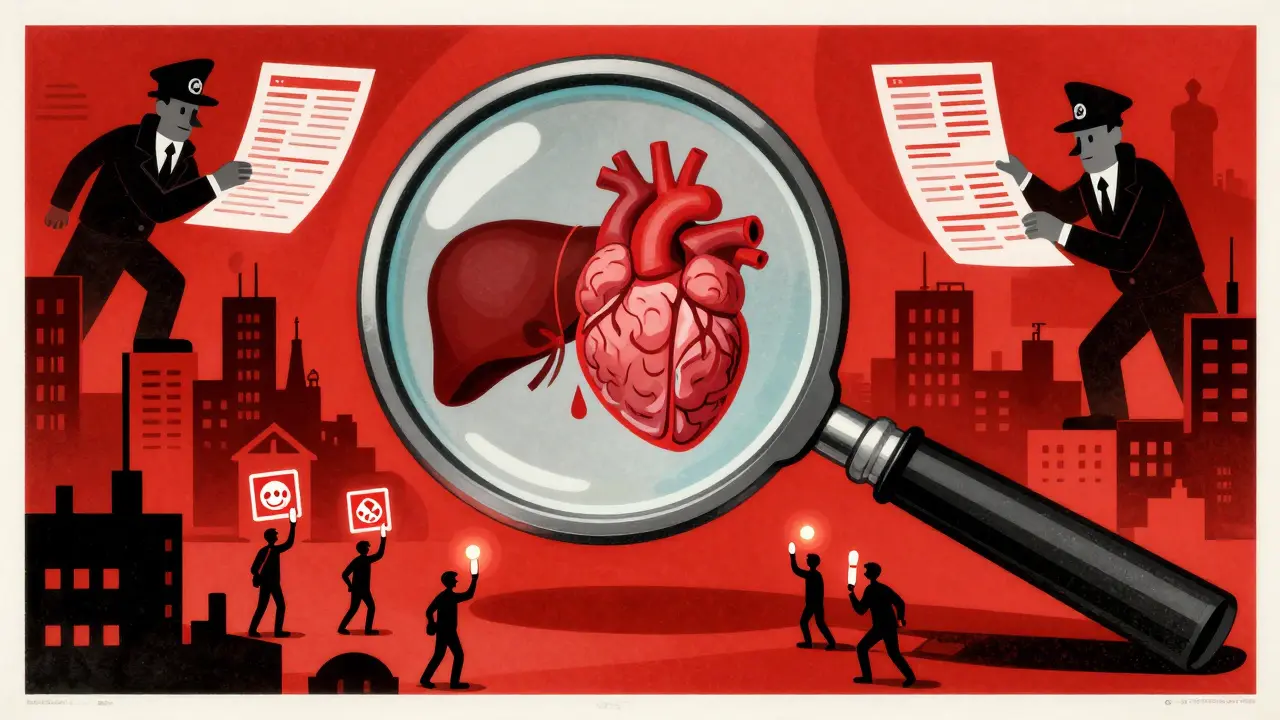
When a new drug hits the market, everyone assumes it’s been thoroughly tested. Clinical trials, after all, involve thousands of patients over years. But here’s the truth: drug safety signals-the early warnings of hidden dangers-often don’t show up until after approval. That’s not a failure. It’s how medicine works. Clinical trials are designed to prove effectiveness and catch the most common side effects. They’re not built to find the rare, the delayed, or the unexpected. That’s where pharmacovigilance steps in.
What Exactly Is a Drug Safety Signal?
A drug safety signal isn’t proof that a medicine causes harm. It’s a red flag. Something unusual pops up in the data, and regulators say: "We need to look closer." The Council for International Organizations of Medical Sciences (CIOMS) defines it clearly: information suggesting a new or changed link between a drug and an adverse event that’s strong enough to warrant investigation. The European Medicines Agency (EMA) says it even simpler: "a new or known side effect that needs checking." These signals come from real-world use. Not the controlled environment of a trial, but the messy, complex world of millions of patients taking the drug alongside other medications, with different health conditions, ages, and lifestyles. A signal might be a sudden spike in reports of liver injury in people taking a new diabetes drug. Or a cluster of rare heart rhythm problems in elderly patients using a new antidepressant. These patterns don’t appear in trials because those trials rarely include enough people-or the right kind of people-to catch them.How Clinical Trials Miss the Warning Signs
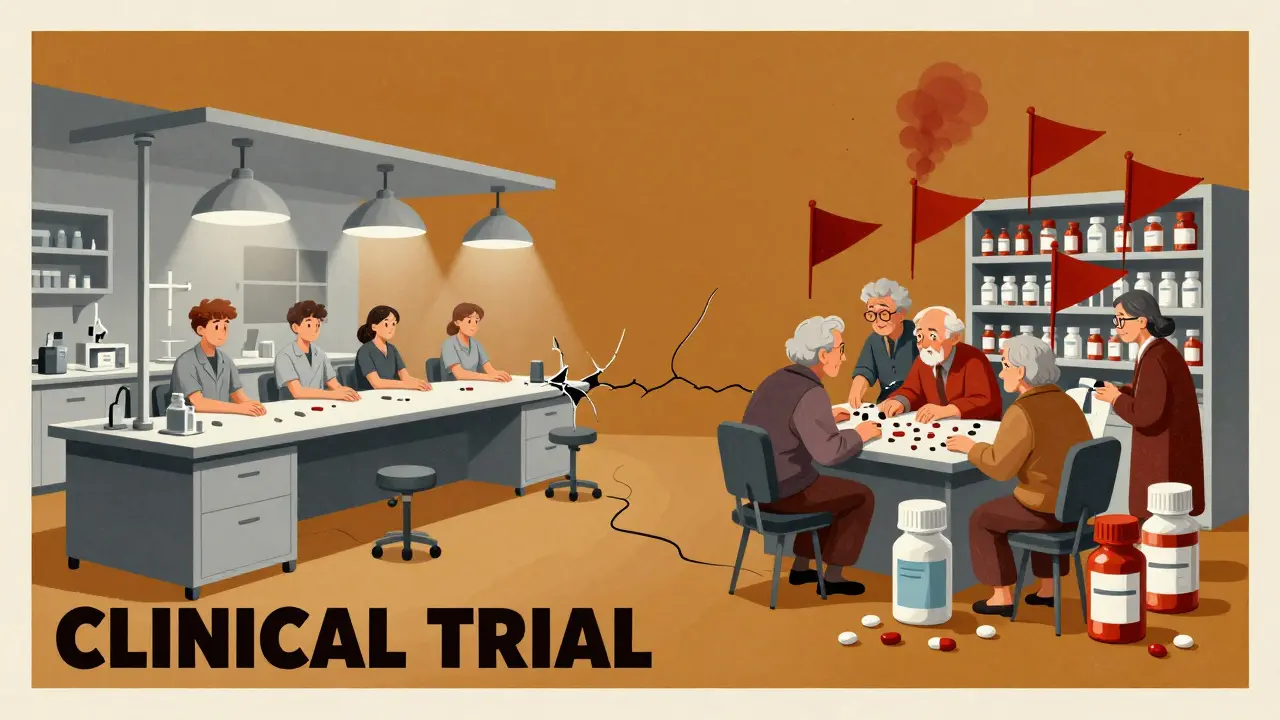
Most clinical trials enroll between 1,000 and 5,000 people. That sounds like a lot. But consider this: if a side effect happens in 1 in 10,000 patients, you’d need 40 trials just to have a 50% chance of seeing it once. And that’s assuming every patient stays on the drug long enough, and the event isn’t masked by other conditions. Trials also exclude people who are most at risk: those with kidney disease, multiple chronic illnesses, or those taking five or more other drugs. They’re often younger, healthier, and monitored closely. Real-world patients? They’re older. They’re on multiple meds. They skip doses. They don’t call their doctor every time they feel off. That’s why the most dangerous signals emerge after approval. The 2004 signal linking rosiglitazone to heart attacks didn’t show up in trials. It emerged from post-marketing reports. The 2018 signal connecting dupilumab to eye surface disease was found through spontaneous reports from ophthalmologists-not clinical trial data. These weren’t flukes. They were predictable gaps in the system.Where Signals Come From: The Data Ecosystem
Signals don’t appear out of nowhere. They’re pulled from a global web of data:- Spontaneous reporting systems: Doctors, pharmacists, and patients report adverse events. The FDA’s FAERS database has over 30 million reports since 1968. EMA’s EudraVigilance handles over 2.5 million per year. These make up about 90% of all signal sources.
- Clinical trials: Even after approval, companies run Phase IV trials to monitor long-term effects.
- Electronic health records (EHRs): The FDA’s Sentinel Initiative now pulls data from 300 million patients across 150 U.S. healthcare systems. That’s real-time monitoring, not waiting for someone to file a report.
- Patient registries and scientific literature: Case studies and published reports can flag patterns regulators didn’t see.
How Regulators Find the Signal in the Noise
Finding a real signal in millions of reports is like listening for a whisper in a hurricane. That’s why they use statistical tools:- Reporting Odds Ratio (ROR): Compares how often an event happens with a specific drug versus other drugs. A ratio above 2.0 triggers attention.
- Proportional Reporting Ratio (PRR): Measures if a side effect is reported more often with one drug than expected.
- Bayesian Confidence Propagation Neural Network (BCPNN): A machine learning method that weighs multiple factors to predict true signals.
What Makes a Signal Actionable?
Not every signal leads to a warning label or a drug recall. Four things make a signal more likely to trigger action:- Replication across sources: If three independent systems show the same pattern, the chance it’s real jumps dramatically. Studies show this makes a signal 4.3 times more likely to lead to a label change.
- Medical plausibility: Does the drug’s mechanism explain the event? A drug that affects blood clotting causing strokes? Plausible. A drug for arthritis causing hair loss? Maybe not.
- Severity of the event: Serious events-hospitalization, death, permanent disability-get priority. 87% of serious signals lead to label updates. Non-serious ones? Only 32%.
- Drug age: New drugs (under 5 years) are watched like hawks. 68% of label updates happen in this window. Older drugs? Much less scrutiny, even if new risks emerge.
The Human Cost of Missed Signals
The system isn’t perfect. Some signals take years to be recognized. Bisphosphonates, used for osteoporosis, were linked to jaw bone death seven years after approval. Why? The event was rare. It needed dental trauma to trigger it. And doctors didn’t connect the dots until enough cases piled up. Worse, many reports are incomplete. A 2022 survey of safety officers found 68% struggle with poor-quality reports-missing patient history, unclear timelines, no follow-up. Without knowing if symptoms improved after stopping the drug (dechallenge) or returned when restarting (rechallenge), causality is guesswork. And then there’s the noise. The 2021 International Society of Pharmacovigilance survey showed 73% of professionals feel frustrated by the lack of standardized ways to judge if a drug caused an event. It’s subjective. It’s slow. And it’s exhausting.
How the System Is Evolving
The field is changing fast. AI is cutting signal detection time from two weeks to under two days. The EMA now uses machine learning to scan EudraVigilance daily. The FDA’s Sentinel system checks data in near real-time. The ICH’s new M10 guideline will standardize lab data reporting, making it easier to spot liver or kidney damage. The biggest shift? Moving from passive reporting to active monitoring. Instead of waiting for reports, regulators are now pulling data directly from hospital systems, pharmacies, and even wearable devices. By 2027, 65% of high-priority signals are expected to come from integrated data-not just forms filled out by doctors. But challenges remain. Biologic drugs-like antibodies and gene therapies-are more complex. Their side effects are harder to predict. And the aging population? More people on more drugs means more interactions, more confusion, and more signals that look real but aren’t.What This Means for Patients
You don’t need to be a scientist to understand this: drug safety signals are the system’s way of saying, "We’re still learning." A warning label doesn’t mean the drug is dangerous. It means we now know how to use it more safely. If your doctor prescribes a new medication, ask: "Has this been on the market long? Are there any known risks we should watch for?" If you experience something unusual, report it. Even if it seems minor. That report could be the first thread in a pattern that saves someone else’s life. The system isn’t flawless. But it’s getting better. And every signal detected, every false alarm filtered out, every label updated-it’s all part of making medicines safer, one piece of data at a time.What’s the difference between a side effect and a safety signal?
A side effect is a known, documented reaction to a drug, listed in its prescribing information. A safety signal is an emerging pattern-something unusual or unexpected-that hasn’t been confirmed yet. It’s a clue, not a conclusion. Side effects are confirmed; signals are under investigation.
Can a drug be pulled from the market because of a safety signal?
Rarely. Most signals lead to updated warnings, restricted use, or additional monitoring-not removal. A drug is only withdrawn if the risk clearly outweighs the benefit and no safer alternatives exist. The 2010 withdrawal of rofecoxib (Vioxx) is a rare example, triggered by multiple signals showing increased heart attack risk across several data sources.
Why do some signals take years to be confirmed?
Some adverse events are rare, delayed, or triggered by complex interactions. Osteonecrosis of the jaw from bisphosphonates took seven years to confirm because it only occurred after dental procedures in older patients with poor oral health. It took time for enough cases to appear, be reported, and be connected to the drug.
Are newer drugs more dangerous than older ones?
Not necessarily. But they’re less understood. New drugs have less real-world data, so signals appear faster and more frequently. Older drugs have been studied longer, so their risks are better mapped. That’s why 68% of label updates happen in the first five years after approval.
How can patients help improve drug safety?
Report any unusual symptoms to your doctor and through official channels like the FDA’s MedWatch or your country’s adverse event reporting system. Even small, seemingly unrelated changes-like a new rash, fatigue, or mood shift-can be important. Your report might be the missing piece in a larger pattern.


Mike Rengifo
December 19, 2025 AT 09:28Been on a new diabetes med for six months. Started getting weird joint stiffness. Didn’t think much of it till I read this. Posted it on MedWatch yesterday. Hope it helps.
Chris Davidson
December 19, 2025 AT 14:15Trials are rigged by design pharma pays for them so of course they miss the real dangers
Kinnaird Lynsey
December 21, 2025 AT 00:02Wow. So we’re just supposed to trust that the system will eventually catch the bad stuff? I mean… I guess that’s better than nothing. But also terrifying.
Andrew Kelly
December 22, 2025 AT 20:29They’re not missing signals they’re burying them. Look at Vioxx. The data was there. They waited until it killed enough people before acting. This isn’t science it’s corporate damage control.
Monte Pareek
December 22, 2025 AT 22:56Look I’ve been in pharma for 20 years and yeah the system is broken but not because of evil corporations. It’s because we’re trying to predict human biology with tiny samples and outdated tools. We need real-time data from EHRs and wearables not waiting for some grandma to fill out a form after she gets dizzy. The FDA’s Sentinel system is already doing this and it’s saving lives. Stop yelling at the system and help build the next version.
Erica Vest
December 24, 2025 AT 22:35The difference between a side effect and a safety signal is critical. Side effects are documented in the prescribing information-e.g., ‘headache reported in 8% of patients.’ A safety signal is an emerging pattern: ‘headaches in patients over 70 taking Drug X and Metformin simultaneously’-a combination not tested in trials. This distinction is foundational to pharmacovigilance and often misunderstood by the public.
Matt Davies
December 26, 2025 AT 06:19It’s like watching a detective show where the clues are scattered across a thousand different crime scenes. Some genius finally connects them-and suddenly you realize the whole town was poisoned. That’s pharmacovigilance. Quiet. Unseen. Vital.
Elaine Douglass
December 28, 2025 AT 04:22My aunt had that jaw thing from the osteoporosis meds. She didn’t even know it was connected till her dentist said something. I’m gonna send this to her doctor. Thank you for writing this.
Mahammad Muradov
December 29, 2025 AT 18:58Anyone who believes the FDA or EMA is protecting patients is naive. The entire system is designed to keep profits flowing. Real safety comes from avoiding new drugs entirely. Stick to aspirin and garlic. That’s what my grandfather did. He lived to 94.
Anna Sedervay
December 31, 2025 AT 07:57While I appreciate the technical exposition, one cannot ignore the epistemological fragility of pharmacovigilance: the reliance on spontaneous, unstandardized, and often anecdotal reporting as the primary arbiter of causality is not merely methodologically unsound-it is a grotesque epistemic failure masquerading as public health policy. The absence of universal biomarkers for adverse events renders the entire edifice speculative at best.