
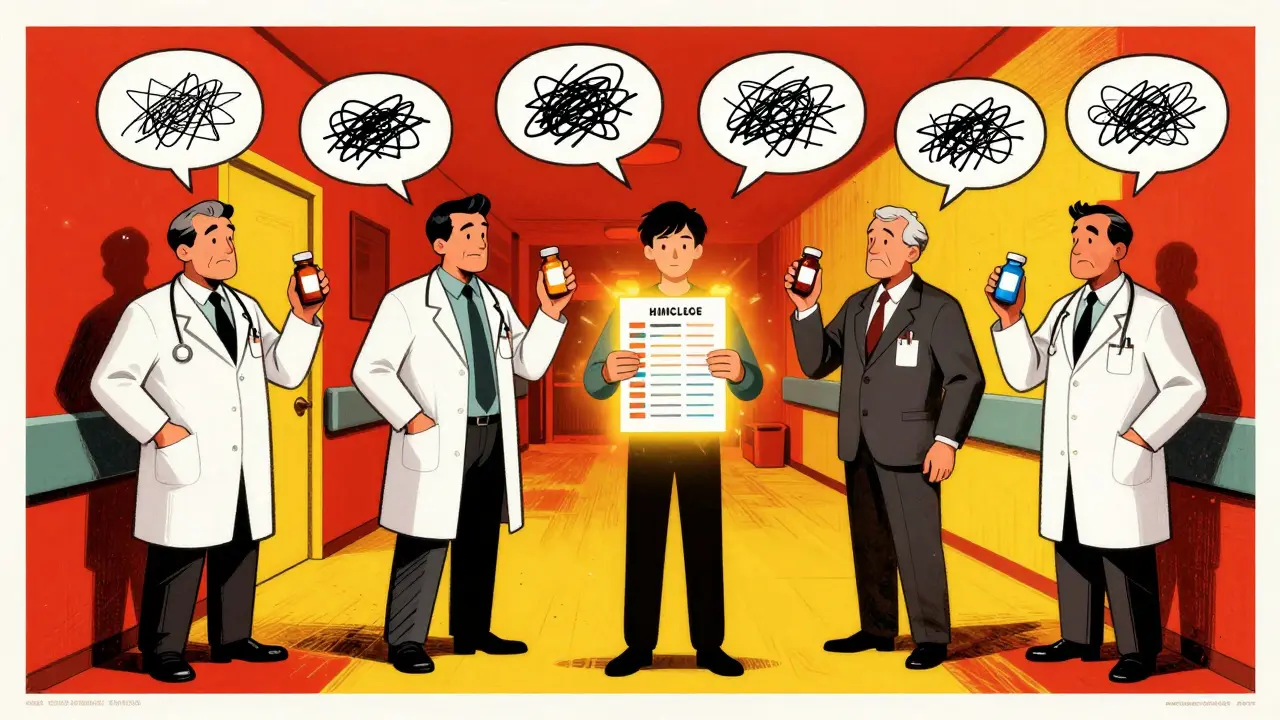
Imagine this: you’re taking five different medications for three separate conditions. One doctor prescribed a new pill last week. Another changed your dose without telling anyone. Your pharmacist caught a dangerous interaction. But your primary care doctor? They had no idea. This isn’t rare. It’s the norm for millions of people juggling multiple providers. And it’s putting lives at risk.
Medication errors from poor communication between healthcare providers cause about 1.5 million injuries every year in the U.S. alone. That’s one person every 20 seconds. Around $3.5 billion is spent annually just to fix mistakes that never should’ve happened. In Australia, similar patterns are emerging as our population ages and chronic conditions multiply. You don’t need to be a statistic. But you do need to take control.
Why Communication Between Providers Breaks Down
It’s not that doctors don’t want to talk. It’s that the system doesn’t make it easy. Most hospitals and clinics use different electronic health record (EHR) systems. Even if they’re from the same vendor, they often don’t talk to each other. A specialist at St. Vincent’s might not see what your GP at Melbourne Health Centre wrote. Your pharmacist might have the full list, but they’re not legally allowed to share it unless you give explicit permission.
Research from the National Institutes of Health found that patients seeing three or more providers are over three times more likely to have conflicting prescriptions. Specialists often prescribe new medications without checking what’s already on your list. In one study, 57% of patients said specialists made changes without consulting their main doctor. And 83% of patients thought their providers were talking to each other-when they weren’t.
Even when records are shared, they’re messy. A medication might be listed as “Lisinopril 10mg” without saying why it was prescribed. Was it for blood pressure? Heart failure? Kidney protection? Without the purpose, a new provider might duplicate a drug or miss a critical interaction.
The Four Essentials of a Perfect Medication List
You don’t need fancy apps or complicated charts. You need a simple, updated list with four key pieces of information for every medication:
- Name - Use the brand name and generic name if you know it. Example: “Lisinopril (Zestril)”
- Dosage - How much you take. “10 mg” not “one pill.”
- Frequency - When and how often. “Once daily, in the morning” not “daily.”
- Purpose - Why you’re taking it. “For high blood pressure” not “for heart.”
That’s it. That’s all. A 2022 study from Happier at Home showed that patients who kept this exact list updated reduced medication errors by 37%. The CDC and Medicare both recommend this format. It’s not complicated. It’s just rarely done.
Keep a physical copy. Carry it in your wallet. Update it every time a provider changes something. Bring it to every appointment-even if you think they already have your file. Assume they don’t.
How to Get Your Providers to Talk to Each Other
Don’t wait for them to coordinate. Be the coordinator.
At every visit, say this: “I’m seeing several providers. Can you please send a summary of what you’re prescribing to my primary care doctor and pharmacist?” Most practices now have secure messaging systems built into their EHRs. If they say no, ask: “Can you give me a printed copy to hand to my other doctors?”
Ask your pharmacist to be your central hub. Pharmacists are trained to spot interactions. They see all your prescriptions. And they’re not pressured by time like doctors are. A 2023 analysis by Asteroid Health found that patients who worked directly with clinical pharmacists had 32% higher medication adherence and 63% more confidence in their regimen.
If you’re on Medicare or have an ACO (Accountable Care Organization), ask if you’re enrolled in a care coordination program. These programs are designed to link your providers. In 2022, ACO patients had 27% fewer medication-related hospital readmissions than those in traditional care.

Use the Teach-Back Method to Avoid Misunderstandings
Even if your doctor explains your meds perfectly, you might still misunderstand. That’s normal. Stress, fear, and complex medical terms make it hard to absorb information.
Try the Teach-Back Method. After your doctor explains, say: “Just to make sure I got it right-can you have me repeat it back?” Then explain the medication in your own words. “So I take this blue pill every morning with food to lower my blood pressure, and I shouldn’t stop it even if I feel fine?”
The Agency for Healthcare Research and Quality found this simple technique reduces misunderstandings by 45%. It works because it turns passive listening into active confirmation. And it gives your provider a chance to correct mistakes before you leave the room.
Track Your Body’s Response
Side effects don’t always show up right away. They creep in. Fatigue. Dizziness. Mood swings. Trouble sleeping. These can be signs of a bad interaction-or a dose that’s too high.
Start a simple health journal. Just a notebook or a note in your phone. Each day, write down:
- Any new symptoms
- Changes in sleep or appetite
- When you felt unusually tired or confused
- Missed doses or skipped pills
University of California San Francisco’s 2023 study found patients who kept this journal had 22% fewer adverse drug events. When you go to your next appointment, bring the journal. Say: “I’ve been tracking how I feel. I noticed this pattern. Could it be my meds?”
What to Do When Things Go Wrong
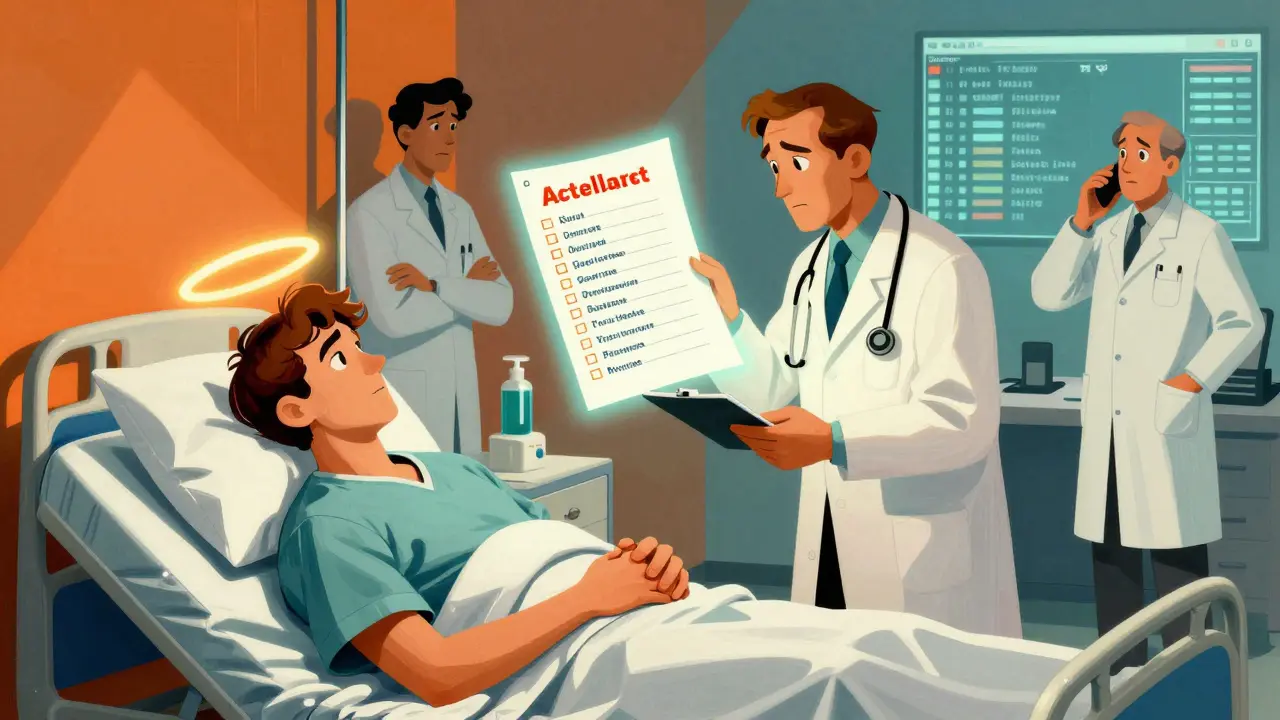
Let’s say you end up in the ER because of a bad interaction. Or a doctor prescribes something that clashes with your other meds. What now?
First, stay calm. Ask: “Can we pause this medication until we check everything else I’m taking?” Most providers will agree.
Second, get your full medication list into their hands. Don’t wait. Hand them your printed list. If they don’t have access to your records, say: “I’ll email it to you right now.”
Third, ask for a medication reconciliation. This is a formal process where a pharmacist or nurse reviews every drug you’re on and compares it to what’s been prescribed. It’s standard in hospitals-but rarely done in outpatient settings unless you ask. Say: “Can you do a full medication reconciliation before I leave?”
And if you feel ignored? Escalate. Ask to speak with the patient advocate or care coordinator. Most hospitals have them. They’re there to help you.
The Future Is Here-And It’s Pharmacists
The most promising shift in medication safety isn’t a new app or AI tool. It’s the growing role of pharmacists as communication hubs.
By 2025, 78% of independent pharmacies in Australia and the U.S. will offer formal Medication Therapy Management (MTM) services. That means you can book a 30-minute appointment with a pharmacist to review all your meds-no referral needed. They’ll check for interactions, simplify your regimen, and even call your doctors to clarify prescriptions.
At Mayo Clinic, AI tools now scan medication lists in seconds. What used to take 15 minutes per patient now takes 47 seconds. But even the best AI can’t replace human conversation. That’s why pharmacists are becoming the glue holding complex care together.
You don’t need to wait for the system to fix itself. Start today. Update your list. Talk to your pharmacist. Ask your doctors to communicate. Be the one who makes sure no one falls through the cracks.
What if my doctors won’t talk to each other?
You can’t force them to communicate, but you can control the flow of information. Always carry a printed, updated medication list. Hand it to every provider. Ask them to fax, email, or upload it to your records. If they refuse, say: “I need this for my safety. Can you please help me get it shared?” Most will comply once they understand the risk.
Do I need to tell my pharmacist about over-the-counter meds and supplements?
Yes. Always. Many dangerous interactions happen between prescription drugs and things like ibuprofen, fish oil, or St. John’s Wort. Your pharmacist is the only provider who sees all your medications-including the ones you buy without a prescription. Include everything: vitamins, herbal remedies, painkillers, and even topical creams. If you’re unsure, ask: “Is this safe with my other meds?”
How often should I update my medication list?
Update it every time there’s a change: a new prescription, a dose change, or when you stop a medication. Keep it in your wallet or phone. Review it monthly. Bring it to every appointment-even if you think nothing changed. Small changes add up. A missed update can mean a dangerous interaction.
Can I ask my pharmacist to call my doctors?
Yes, and you should. Many pharmacists now offer this as part of Medication Therapy Management. Ask: “Can you contact my doctors to clarify or coordinate my prescriptions?” They can often resolve issues faster than you can. If they say no, ask why-and if they can refer you to one who does.
What if I’m taking too many medications?
You’re not alone. Nearly 1 in 3 adults over 65 take five or more medications. But more isn’t always better. Ask your pharmacist or GP: “Is there anything I can stop or reduce?” A 2022 study found that 41% of medications started by specialists conflicted with existing regimens. A careful review might eliminate unnecessary drugs-and reduce side effects.
Ashlyn Ellison
February 7, 2026 AT 05:54This is so spot on. I’ve been managing my mom’s meds for years-she’s on 8 pills, and every time we see a new specialist, they add another without asking what she’s already taking. Last month, she ended up in the ER because two drugs clashed. We had to print out her list, hand it to every doctor, and beg them to read it. The system is broken, but the fix is stupidly simple: carry the list. Always. Even if you think they have it. They don’t.
Update it after every change. Even if it’s just a dose tweak. Even if it’s a new vitamin. Write it down. Keep it in your purse. Send it to your kids. Make it a ritual. It’s not about being ‘difficult’-it’s about not dying because someone forgot to click ‘send’.
Ritteka Goyal
February 8, 2026 AT 05:42OMG YES I’M SO GLAD SOMEONE FINALLY SAID THIS I’VE BEEN TELLING MY DOCTORS IN INDIA THAT THEY NEED TO TALK TO EACH OTHER BUT NOOOO THEY’RE TOO BUSY WITH THEIR EHR SYSTEMS THAT DON’T TALK TO EACH OTHER LOL
MY GRANDMA IS ON 11 MEDS AND ONE DOCTOR GAVE HER A NEW PILLS FOR ‘JOINT PAIN’ AND IT MADE HER BLOODY DIZZY BECAUSE IT INTERACTED WITH HER BLOOD PRESSURE DRUG AND NOBODY KNEW BECAUSE THE SPECIALIST JUST THOUGHT ‘OH SHE’S SEEN HER GP’ AND THE GP THOUGHT ‘OH SHE’S SEEN THE CARDIOLOGIST’
SO I STARTED CARING A LITTLE NOTEBOOK IN MY BACKPACK AND I SHOW IT TO EVERYONE AND NOW THEY JUST ASK ME FOR IT WHEN I WALK IN LIKE ‘OH YEAH THE LIST’ AND I’M LIKE YEAH BABY I’M THE MEDICATION QUEEN NOW
PS: TELL YOUR PHARMACIST ABOUT EVERYTHING EVEN THE TURMERIC CAPSULES I DIDN’T AND MY STOMACH WENT ON A STRIKE LOL
Chelsea Cook
February 9, 2026 AT 06:04Oh honey. You’re telling me you didn’t know that 80% of medication errors happen because someone assumed ‘they already know’? Welcome to healthcare in 2025. The system doesn’t care if you live or die. It cares if the billing code was entered correctly.
Here’s your real power move: when they hand you a new script, say ‘I’m going to have my pharmacist call your office to confirm this doesn’t conflict with my other meds.’ Watch them panic. Then watch them send the fax. It’s not rude. It’s survival.
And yes, your pharmacist is your new best friend. They’re the only one who’s paid to care. Don’t let them feel unappreciated. Bring them cookies. They’ll remember you.
Monica Warnick
February 9, 2026 AT 11:37Wow. This is basically the entire reason I stopped seeing specialists. I had 4 doctors last year. Each one prescribed something new. One of them gave me a drug that caused hallucinations. I didn’t realize it was the med until I googled ‘why am I seeing spiders at 3am’.
Turns out, it was a combo of three prescriptions and one herbal tea I thought was ‘harmless’.
I now have a laminated card in my wallet. It says: ‘I am not a data point. I am a human with a brain. Please read my list.’
It works. Mostly. The last doctor said ‘I don’t have time for this’ and I walked out. I’m fine. I’m alive. And I’m not going back.
Simon Critchley
February 9, 2026 AT 16:34Let’s not sugarcoat this: the fragmentation of EHRs isn’t an accident-it’s a feature. Healthcare is a $4T industry built on siloed data. If your providers could talk, they’d lose billing leverage. Why would a hospital want to share your full history if it means another provider might ‘steal’ your follow-up visits?
And don’t get me started on the ‘pharmacist as coordinator’ fantasy. Most are overworked, underpaid, and legally barred from initiating communication with providers unless you’re in a state with expanded scope laws.
Real solution? National interoperable EHR. Single ID for all patients. Mandatory reconciliation. Or we keep drowning in preventable errors while CEOs cash in on the chaos.
Frank Baumann
February 11, 2026 AT 14:54Bro I had a cousin who died because of this. Not exaggerating. She was 52. Had diabetes, hypertension, depression. Took 7 meds. New psychiatrist gave her a new SSRI. Her PCP had no idea. Her pharmacist saw it but didn’t have authority to call. She had a seizure at home. No one knew what she was on. They found her with her meds in a shoebox labeled ‘random pills’.
I started a Google Doc. Shared it with everyone. Now I have a QR code on my phone. Scan it, see my entire med list. Updated in real time. I even added supplements. I told my mom: ‘If I’m unconscious, scan the code. Don’t ask me. Don’t guess. Just scan.’
It’s not a hack. It’s a lifeline. And if you’re not doing this? You’re gambling with your life. And you don’t even know the odds.
Scott Conner
February 13, 2026 AT 12:51wait so you’re saying i should just… ask? like… out loud? and carry paper? and talk to the pharmacist? i thought the doctors were supposed to handle this? i’m just here for the pills…
also i take 3 things and i forget what half of them are for. is that bad?
Camille Hall
February 14, 2026 AT 05:36Thank you for writing this. I’m a nurse, and I see this every single shift. Patients come in with 10+ meds, no list, no idea why they’re taking them. We have to call 3 different clinics, beg for records, and sometimes the only thing we get is a receipt from CVS with ‘meds’ scribbled on the back.
But here’s what works: when I teach patients the four essentials (name, dose, frequency, purpose), they go from confused to empowered. One woman told me, ‘I didn’t know I was taking two blood pressure pills until I wrote it down.’ She cried. I cried.
You don’t need tech. You need clarity. And you deserve to be heard. Start today. Write it down. Bring it. Repeat. You’re not being annoying-you’re being smart.
Kathryn Lenn
February 14, 2026 AT 07:47Let’s be real-the whole ‘carry a list’ thing is just a Band-Aid on a hemorrhage. The real issue? The pharmaceutical-industrial complex profits from polypharmacy. More drugs = more revenue. More confusion = more repeat visits. More ER trips = more billing codes.
And don’t believe the ‘pharmacist as hero’ narrative. They’re just the last line of defense before you end up on a ventilator. The system is designed to fail you. The ‘tips’ here are cute. But they’re not solutions. They’re survival tactics for a broken machine.
And yes, I’ve been to 3 different ERs because of this. Each time, they said ‘we’ll look into it.’ Never did. I stopped trusting them. Now I just Google every pill. And I don’t take anything unless I can prove it’s not going to kill me.
Marie Fontaine
February 15, 2026 AT 01:56you got this. <3
Ryan Vargas
February 17, 2026 AT 00:21There’s a deeper truth here, and it’s not about lists or pharmacists. It’s about the collapse of the Hippocratic ideal into bureaucratic transactionalism. Medicine was once a covenant between healer and patient. Now it’s a supply chain. Each provider is a node in a network optimized for throughput, not care. The EHRs don’t talk because interoperability would threaten the proprietary ecosystems of Epic, Cerner, and Allscripts-corporations that make billions from data lock-in.
The ‘Teach-Back Method’? A bandage. The ‘medication list’? A placebo. What we need is structural reform: public EHR infrastructure, mandatory communication protocols, and legal liability for providers who prescribe without full reconciliation.
And while we’re at it-why is the pharmacist the only one allowed to coordinate? Because they’re the lowest paid, most overworked, and least legally protected. The system outsources its moral burden to the people who can least afford it.
This isn’t about patient responsibility. It’s about institutional failure. And until we name it as such, we’re just rearranging deck chairs on the Titanic.
Ashlyn Ellison
February 18, 2026 AT 07:29Actually, I just got a call from my pharmacist. She called my PCP and my cardiologist. They both said ‘we’ll update the records.’ I asked if they’d send me a copy. They did. In 48 hours.
Turns out, all it took was one person asking. Not me. My pharmacist. She did it because I reminded her I’d brought her cookies last month.
So yeah. Carry the list. But also-be kind to your pharmacist. They’re the only ones still trying.