
Why Pediatric Medication Errors Are So Common
Children don’t just get smaller doses of adult medicine-they need completely different calculations. A 5-year-old weighing 18 kg isn’t a 70 kg adult scaled down. One wrong decimal point, one misread pound-to-kilogram conversion, and you’ve given a child a toxic dose. According to the World Health Organization, kids are three times more likely than adults to suffer a medication error. Most of these errors come from weight-based dosing mistakes. It’s not just about math. It’s about systems that fail at every step: outdated weights on charts, mixed units (pounds vs. kilograms), manual calculations, and alerts that get ignored because they’re too frequent or inaccurate.
The Weight-Based Verification Rule: Three Points of Check
The most effective way to stop these errors isn’t a single fix-it’s three checks, built into the workflow. First, when the doctor writes the order. Second, when the pharmacist fills it. Third, when the nurse gives it at the bedside. This isn’t optional. The Institute for Safe Medication Practices calls this the gold standard. If any one of these steps is missing, the system breaks. A 2022 study showed that hospitals using all three checks cut pediatric dosing errors by more than 80%. But in places where only one check exists, error rates stayed high. The key is making each step mandatory, not optional. No weight? No order. No verified weight? No medication leaves the pharmacy.
Why Kilograms Only-No Exceptions
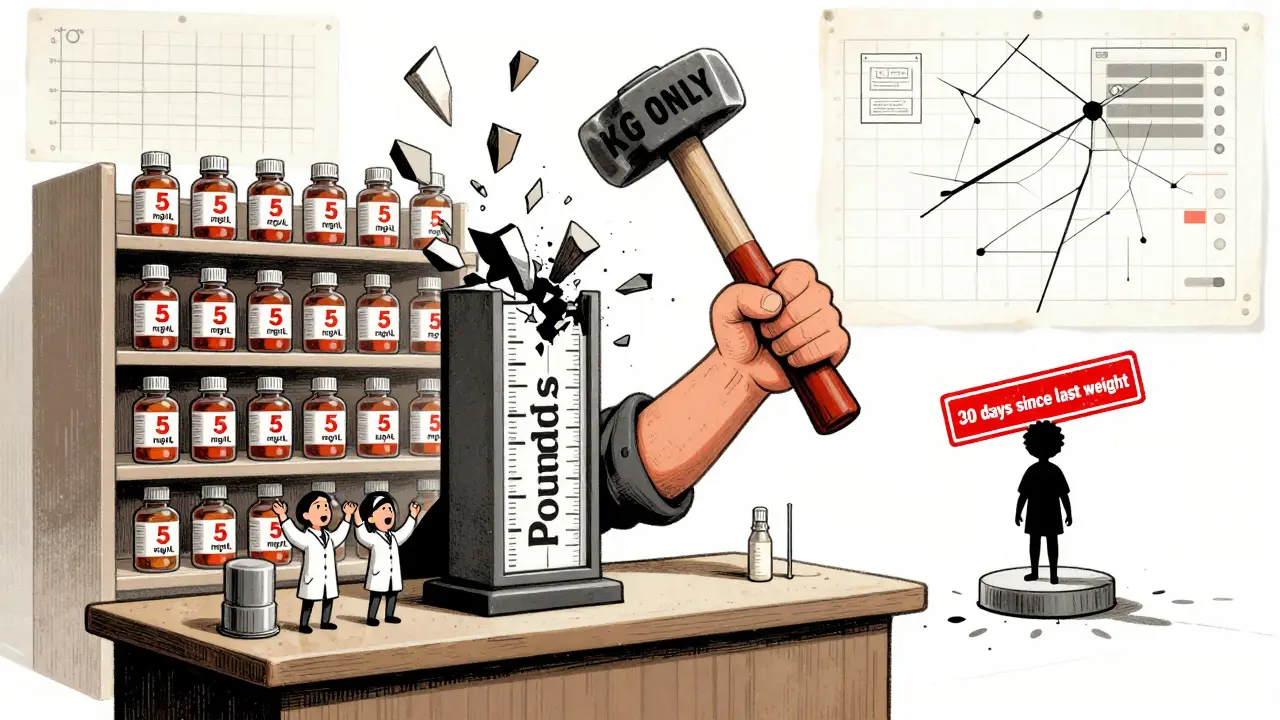
Pounds are the enemy of pediatric safety. Every time a clinician converts 40 pounds to kilograms in their head, they’re risking a mistake. The American Society of Health-System Pharmacists made it clear: all pediatric weights must be documented in kilograms only. No exceptions. No dual displays. No “we’ve always done it this way.” Digital scales in pediatric units should show only kilograms-with precision to 0.1 kg for babies and 0.5 kg for older kids, as recommended by the American Academy of Pediatrics. Even small rounding errors add up. A 10% miscalculation in weight means a 10% overdose in a child. That’s not a typo. That’s a medical emergency. Hospitals that switched to kilogram-only systems saw a 90% drop in conversion-related errors within a year.
How Technology Can Help-And Hurt
Electronic health records (EHRs) with built-in clinical decision support can cut errors by up to 87%. But only if they’re set up right. Many systems still trigger alerts for doses that are actually safe-like when a teenager is nearing adult weight. Pharmacists on Reddit report that Epic and other EHRs flood them with false alarms, leading to alert fatigue. Clinicians start ignoring them. That’s dangerous. The latest update from Epic in January 2024 uses growth percentiles instead of fixed weight limits, reducing false alerts by over 60%. That’s the kind of smart design that works. But technology alone isn’t enough. If your pharmacy system doesn’t require weight entry before allowing a prescription to be processed, no alert will save you. The system must be locked-no weight, no go.
Standardizing Concentrations Saves Lives
Imagine two different concentrations of the same antibiotic: one is 25 mg/mL, another is 50 mg/mL. If a nurse grabs the wrong bottle, even with the right weight, they’ll give the wrong dose. That’s why hospitals that standardize concentrations see 72% fewer calculation errors. Vancomycin, amoxicillin, morphine-these drugs should be available in only one strength per unit. No variations. No exceptions. This isn’t about convenience. It’s about reducing cognitive load. When every liquid medication in pediatrics uses the same concentration, pharmacists and nurses don’t have to remember which one is which. It’s a simple fix, but only 38% of U.S. hospitals have fully adopted it. The ones that did saw fewer delays, fewer errors, and less stress on staff.
The Human Factor: Training and Culture
Even the best system fails if people aren’t trained. A 2022 survey found that nearly 38% of pharmacy staff lacked basic knowledge of pediatric pharmacokinetics. That’s not their fault-it’s a training gap. Effective programs require 40 hours of hands-on training per clinician, including real case simulations. But training isn’t enough. You need a culture where reporting a near-miss isn’t punished. At Boston Children’s Hospital, after implementing weight checks, staff started reporting more errors-not because they were making more, but because they felt safe to speak up. That’s how you find the hidden flaws. The Leapfrog Group now requires proof of weight verification systems to give a hospital an “A” safety grade. That’s changing behavior at the institutional level.
What Happens in Rural and Community Pharmacies
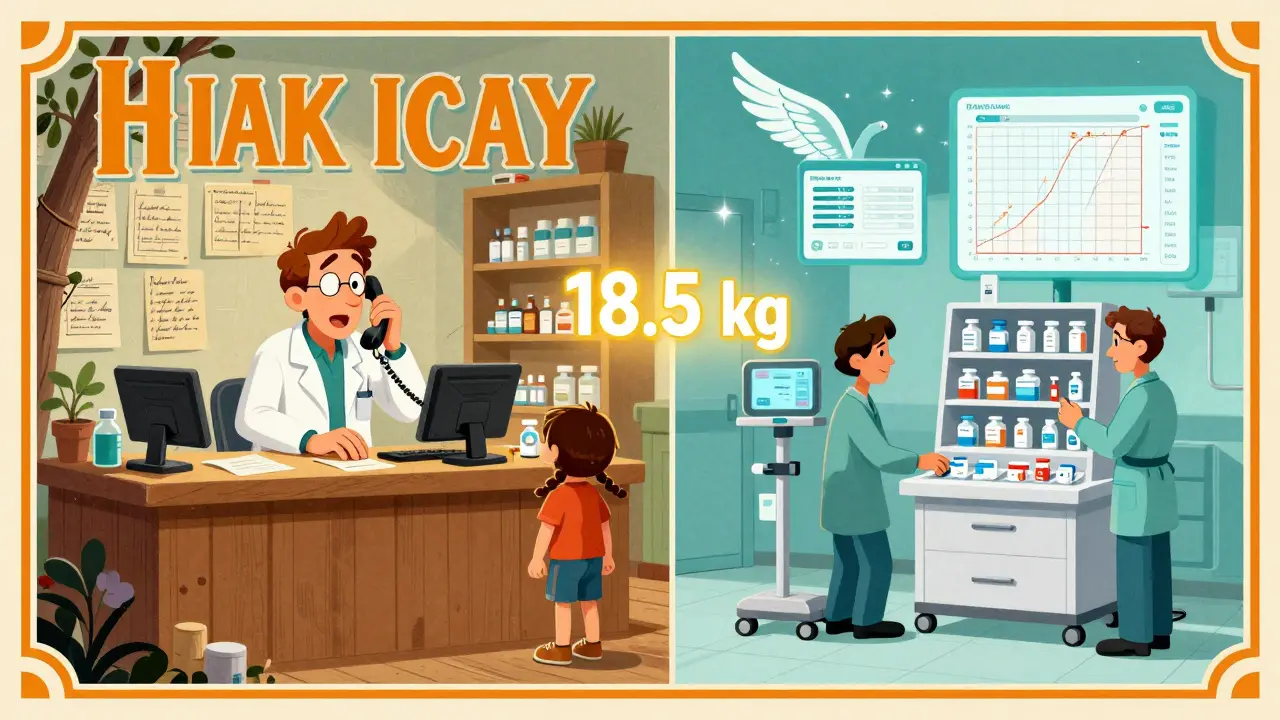
The problem isn’t just in big hospitals. In rural clinics and community pharmacies, 68% don’t have access to the patient’s EHR. That means pharmacists are filling pediatric prescriptions without knowing the child’s current weight. A 2023 survey found that 28% of community pharmacists had a near-miss due to outdated or missing weight data every month. That’s unacceptable. These pharmacies need simple solutions: printed weight verification forms, mandatory calls to the prescribing clinic, or even smartphone apps that link to state immunization registries that often include recent weight data. Without these, children in underserved areas are at higher risk. The gap between academic hospitals (94% with full systems) and rural clinics (33%) isn’t just a statistic-it’s a safety crisis.
What You Can Do Right Now
You don’t need a $2 million EHR upgrade to start preventing errors. Here’s what works immediately:
- Make sure every child’s weight is measured and entered in kilograms within 24 hours of admission or visit.
- Remove all pound-based scales from pediatric units. Replace them with digital scales that display only kg.
- Require pharmacy staff to verify weight against the chart before dispensing any pediatric medication.
- Use only one concentration per drug (e.g., 5 mg/mL for amoxicillin) across your facility.
- Train every nurse and pharmacist on the “three-point check” rule.
These aren’t fancy tech solutions. They’re basic safety habits. And they work. One community hospital in Ohio cut pediatric dosing errors by 76% in six months just by enforcing these five steps.
The Future: Smarter Systems, Safer Kids
Next-gen tools are already here. AI is being tested to predict a child’s expected weight based on age, height, and past records. If the system sees a 3-year-old with a recorded weight of 45 kg, it flags it-because that’s impossible. The FDA is pushing for growth charts to be auto-linked to dosing engines. Blockchain is being explored to lock weight data so it can’t be changed retroactively. Wearables for kids with chronic conditions could send real-time weight updates to the pharmacy. But none of this matters if the culture doesn’t change. As Dr. Robert Wachter at UCSF says: “Technology can’t prevent errors. People can.” The goal isn’t perfect systems. It’s a team that checks, questions, and speaks up-every time.
Why are weight-based errors so common in pediatric care?
Weight-based errors happen because pediatric dosing requires precise calculations in mg/kg or mg/m², and small mistakes-like confusing pounds with kilograms or using outdated weights-lead to dangerous overdoses or underdoses. Children’s bodies process drugs differently than adults, so even a 10% miscalculation can be life-threatening. Studies show 15-20% of pediatric medication errors stem from weight conversion mistakes, and 32.7% of all dispensing errors involve incorrect weight-based dosing.
What’s the most effective way to prevent pediatric dosing errors?
The most effective method is mandatory weight-based verification at three points: when the order is written, when the pharmacy dispenses the medication, and when the nurse administers it. Hospitals using this three-point check have seen error reductions of over 80%. Combining this with kilogram-only documentation, standardized drug concentrations, and clinical decision support in EHRs creates a layered safety net that’s proven to work.
Why must pediatric weights be recorded only in kilograms?
Pounds-to-kilograms conversions are a leading cause of dosing errors. Manual math introduces rounding mistakes, misreads, and forgotten decimals. The American Society of Health-System Pharmacists and the American Academy of Pediatrics mandate kilogram-only documentation because it eliminates this conversion step entirely. Digital scales that display only kilograms reduce errors by up to 90%. Even a 0.5 kg error can lead to a 10% overdose in a small child-something that’s easily avoided by removing pounds from the process.
Can technology alone prevent pediatric dispensing errors?
No. While EHRs with clinical decision support can reduce errors by up to 87%, they fail if alerts are ignored or poorly designed. Many systems generate too many false positives, leading to alert fatigue. Clinicians start overriding warnings-even when they’re valid. The best systems use adaptive algorithms (like Epic’s 2024 update) that adjust to growth percentiles, not fixed weights. But even the smartest tech won’t help if staff aren’t trained, if weights aren’t updated, or if there’s no culture of double-checking. People make the system work-or break it.
What should community pharmacists do if they don’t have access to EHRs?
Community pharmacists without EHR access must create their own safety net. Always ask for the child’s most recent weight and confirm it with the prescribing provider if it’s older than 30 days. Use printed weight verification forms. Link to state immunization registries, which often include recent weight data. Never dispense a pediatric medication without a current weight. If weight is missing, hold the prescription and call the clinic. One study found that 28% of community pharmacists had a near-miss monthly due to missing weight data-this is preventable with simple verification steps.
How do standardized drug concentrations help reduce errors?
When the same drug comes in multiple concentrations (like amoxicillin at 25 mg/mL and 50 mg/mL), nurses and pharmacists must calculate the correct volume each time. That’s a recipe for mistakes. Standardizing to one concentration per drug-say, 5 mg/mL for all liquid antibiotics-means staff only need to remember one number. A 2023 study showed this reduced calculation errors by 72.4%. It’s a simple change that cuts down on confusion, speeds up dispensing, and makes training easier.
What’s the biggest obstacle to implementing weight-based verification?
The biggest obstacle isn’t technology-it’s culture. Many clinicians resist changes that slow them down, even if they save lives. Others assume “I’ve never made a mistake before,” or “this kid looks fine.” Outdated weights on charts, lack of training, and fear of reporting errors keep systems from working. Successful programs fix this by making verification mandatory, not optional, and by creating a blame-free environment where staff feel safe speaking up about near-misses.
How often should a child’s weight be rechecked?
For acute care settings like hospitals or ERs, weight must be measured and recorded within 24 hours of admission. For outpatient clinics and chronic care, it should be updated every 30 days. The Institute for Safe Medication Practices warns that weight-based systems fail when weights are outdated. A child who gained 5 kg since their last visit might get a dangerously low dose if the old weight is still in the system. Always verify the most recent, measured weight-not the last one on file.