
Sterile manufacturing is the process that ensures injectable drugs are completely free of microorganisms. Unlike oral medications, injectables enter the bloodstream directly, so any contamination can cause life-threatening infections. The 2012 New England Compounding Center outbreak, which killed 64 people, shows why these standards are non-negotiable. This article breaks down the exact requirements for sterile manufacturing of injectables.
Regulatory Standards That Save Lives
Regulatory bodies worldwide enforce strict rules for sterile manufacturing. In the U.S., FDA 21 CFR Parts 210 and 211 govern current Good Manufacturing Practices (cGMP) for drugs require sterilization processes to achieve a Sterility Assurance Level (SAL) of 1 in 1 million. The EU's GMP Annex 1 revised in 2022 to emphasize continuous monitoring and risk management mandates similar standards. The World Health Organization's Technical Report Series No. 961 specifies that injectables must have a contamination probability of less than one in a million. These rules exist because a single contaminated vial can lead to sepsis or death.
Terminal Sterilization vs. Aseptic Processing
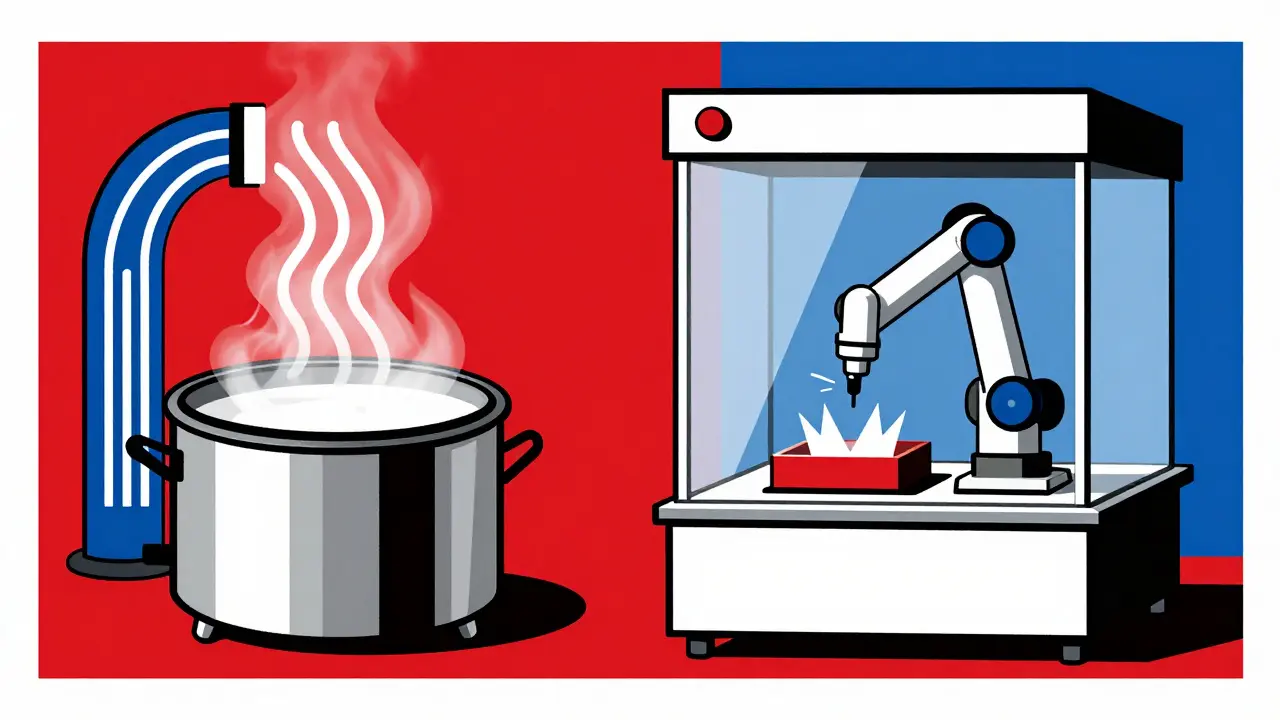
Two main methods exist for sterilizing injectables. Terminal sterilization uses heat or radiation to sterilize sealed containers after filling is preferred by the FDA for products that can withstand high temperatures. This method involves steam at 121°C for 15-20 minutes or gamma radiation at 25-50 kGy doses. However, it only applies to 30-40% of injectables, like saline solutions, because biologics like monoclonal antibodies degrade under heat. For heat-sensitive drugs, aseptic processing maintains sterility throughout production without terminal sterilization is used. This method requires isolators or RABS systems to maintain ISO 5 cleanroom conditions. According to Vetter Pharma's 2022 report, aseptic processing costs 2.5 times more per batch than terminal sterilization due to higher facility and testing requirements.
Cleanroom and Environmental Controls
Cleanroom standards are critical for sterile manufacturing. The ISO classification system defines particle limits for each room. ISO 5 cleanrooms used for aseptic filling zones allow no more than 3,520 particles per cubic meter at 0.5μm size. Air change rates must be 20-60 per hour, with pressure differentials of 10-15 Pascals between adjacent rooms. Temperature and humidity controls are set at 20-24°C and 45-55% RH. Continuous monitoring with particle counters is required under EU GMP Annex 1, replacing older periodic checks. These controls prevent airborne contaminants from entering the product during filling.
Water and Container Requirements
Water for Injection (WFI) must meet strict purity standards. WFI is used in injectable drug formulations must have endotoxin levels below 0.25 EU/mL per USP <85>. Containers must undergo depyrogenation at 250°C for 30 minutes or equivalent to destroy heat-stable toxins. Container closure integrity testing requires detecting leaks as small as 10^-6 mbar·L/s using helium leak testing. These steps ensure no contaminants enter the final product during manufacturing.
Common Challenges and Real-World Costs
Sterile manufacturing faces significant operational hurdles. FDA inspection data shows 68% of deficiencies relate to aseptic technique failures. In 2023, a major pharma company reported three media fill failures due to glove defects in their RABS system, costing $450,000 in batch losses. A BioPhorum survey of 45 facilities found 68% experienced at least one sterility test failure annually, averaging $1.2 million per event. However, solutions exist: Lonza's Stein facility reduced deviations by 45% and sped up batch releases by 30% using continuous monitoring systems. Investing in automated visual inspection can cut defect rates from 0.2% to 0.05%, though this requires $2.5 million upfront.
Future Trends in Sterile Manufacturing
Technology is reshaping sterile manufacturing. The FDA's 2023 guidance emphasizes continuous manufacturing and advanced process controls. ISO 14644-17:2023 now requires real-time environmental monitoring. Closed processing systems, which eliminate manual interventions, are used in 65% of new facilities. Rapid microbiological methods are reducing test times from two weeks to 24 hours. AI-driven inspection tools are part of the FDA's 2024-2026 strategic plan to cut deficiencies by 25%. With the global sterile injectables market projected to reach $350 billion by 2028, facilities must invest in Annex 1 compliance upgrades to stay competitive.
What is the sterility assurance level (SAL) required for injectables?
Injectables must achieve a Sterility Assurance Level (SAL) of 10^-6, meaning no more than one contaminated unit in one million. This standard is mandated by WHO Technical Report Series No. 961, FDA regulations, and EU GMP Annex 1. Achieving this level requires validated sterilization processes and rigorous environmental controls.
What's the difference between terminal sterilization and aseptic processing?
Terminal sterilization uses heat or radiation to sterilize sealed containers after filling and is suitable for heat-stable products like saline solutions. Aseptic processing maintains sterility throughout production without terminal sterilization and is used for heat-sensitive biologics like monoclonal antibodies. Terminal sterilization is cheaper but limited to 30-40% of injectables, while aseptic processing costs 2.5 times more per batch but is necessary for sensitive drugs.
What are the key requirements for cleanrooms in sterile manufacturing?
Cleanrooms for sterile manufacturing follow ISO classifications. ISO 5 zones (aseptic filling) must have fewer than 3,520 particles per cubic meter at 0.5μm size. Air change rates range from 20-60 per hour, with pressure differentials of 10-15 Pascals between rooms. Temperature and humidity are controlled at 20-24°C and 45-55% RH. Continuous monitoring is required under EU GMP Annex 1 to ensure ongoing compliance.
Why is water for injection (WFI) important in sterile manufacturing?
WFI is the water used in injectable drug formulations and must meet strict purity standards. It must have endotoxin levels below 0.25 EU/mL as per USP <85>. Contaminated WFI can introduce pyrogens into the final product, causing fever or septic reactions. Proper WFI production involves distillation or reverse osmosis with rigorous testing.
What are the most common FDA inspection deficiencies in sterile manufacturing?
FDA inspections in 2022 found that 68% of deficiencies related to aseptic technique failures, 28% to media fill testing issues, and 22% to inadequate personnel training. Other common issues include insufficient environmental monitoring and container closure integrity failures. These problems often lead to batch rejections, costly recalls, or facility shutdowns.
Phoebe Norman
February 5, 2026 AT 11:23SAL 10^-6 mandatory for injectables
one contaminated vial causes sepsis death
FDA 21 CFR 210-211 EU Annex 1 enforce this
no room for error
Albert Lua
February 6, 2026 AT 07:06Global standards like WHO TRS 961 and EU Annex 1 ensure consistency across borders
Collaboration between US FDA and EU regulators saves lives
Different countries adapt but core principles remain
This is why sterile manufacturing is a global effort
Carl Crista
February 7, 2026 AT 16:46Global standards controlled by big pharma
FDA EU in cahoots to keep small companies out
Real reason for strict rules is profit
No one cares about safety they just want monopoly
Kate Gile
February 8, 2026 AT 03:03Collaboration between regulators and manufacturers is key
Continuous monitoring systems like Lonza's reduce errors
Investing in tech pays off long-term
We need more innovation in sterile manufacturing
lance black
February 8, 2026 AT 06:11Automation cuts defects from 0.2% to 0.05%
$2.5M upfront but worth it
30% faster batch releases
Safety first
Dina Santorelli
February 8, 2026 AT 23:24Big pharma profits while others suffer.
Gregory Rodriguez
February 10, 2026 AT 22:59Oh sure throw millions at automation
But personnel training is ignored
Classic 'solution' thinking - laughable
Pamela Power
February 12, 2026 AT 03:43Your sarcasm is as shallow as your understanding
Training failures cause 68% of FDA deficiencies
Ignoring tech is irresponsible
You're part of the problem
anjar maike
February 13, 2026 AT 09:05Endotoxin levels below 0.25 EU/mL
WFI production via distillation or reverse osmosis
Maintaining consistency is the real challenge
🤔
Sam Salameh
February 15, 2026 AT 06:44WFI standards are non-negotiable
US has the strictest regulations
Other countries should follow our lead
It's about safety not politics
Cole Streeper
February 16, 2026 AT 05:27US standards are too lenient
Big pharma controls everything
FDA in bed with manufacturers
Real safety needs stricter rules
Jenna Elliott
February 16, 2026 AT 19:43US leads in sterile manufacturing
Other countries copy us
Without US standards we'd have more deaths
It's our responsibility to lead
divya shetty
February 18, 2026 AT 12:50US standards are not universally applicable
Different regions have different needs
Blindly following US regulations ignores local contexts
A more nuanced approach is required