

Tramadol Medication Interaction Checker
Based on your inputs, your serotonin syndrome risk is:
High-risk combinations require immediate medical attention:
- Tramadol + SSRI/SNRI/MAOI
- Tramadol + Triptans
- Tramadol + St. John's Wort
Safer Alternatives
For patients taking serotonergic medications, consider these alternatives:
- Tapentadol - 63% lower serotonin syndrome risk
- Acetaminophen or NSAIDs for mild pain
- Physical therapy for chronic pain
- Non-opioid neuropathic pain drugs (gabapentin, pregabalin)
Always consult your doctor before changing medications.
Most people think of opioids as painkillers that cause drowsiness, constipation, or addiction. But tramadol isn’t like morphine or oxycodone. It’s different. And that difference can be deadly.
Why Tramadol Is Not Like Other Opioids
Tramadol works in two ways. First, it binds to opioid receptors in your brain - weakly, about 6,000 times less than morphine. That’s why it was once considered a "safer" opioid. But here’s the catch: it also blocks the reuptake of serotonin and norepinephrine. That’s the same mechanism used by antidepressants like Prozac and Cymbalta. This dual action makes tramadol unique among opioids. While morphine, fentanyl, or hydrocodone rarely cause serotonin syndrome on their own, tramadol can - even at normal doses. And when combined with antidepressants, the risk jumps dramatically. A 2015 study of 187,000 Medicare patients found that taking tramadol with an SSRI tripled the chance of serotonin syndrome compared to taking the antidepressant alone. That’s not a small risk. That’s a red flag.What Is Serotonin Syndrome?
Serotonin syndrome isn’t just "feeling off." It’s a life-threatening condition caused by too much serotonin in your brain. Symptoms can show up within hours - sometimes even after just one or two pills. Classic signs include:- Shivering or muscle rigidity
- Clonus (involuntary muscle spasms, especially in the legs)
- High fever (over 38°C or 100.4°F)
- Fast heart rate and high blood pressure
- Sweating, confusion, agitation
- Loss of coordination, seizures
Who’s at Highest Risk?
You don’t have to be taking a lot of tramadol to be in danger. The risk spikes if you:- Take an SSRI, SNRI, or MAOI (like fluoxetine, sertraline, venlafaxine, or phenelzine)
- Take triptans for migraines (sumatriptan, rizatriptan)
- Have depression, anxiety, or bipolar disorder
- Are over 65 - older adults are 2.7 times more likely to develop serotonin syndrome on tramadol
- Are a poor metabolizer of CYP2D6 - about 7% of white people are, meaning their bodies can’t break down tramadol properly, leading to dangerous buildup

Why Doctors Still Prescribe It
Tramadol isn’t all bad. For some people with neuropathic pain - like diabetic nerve pain - it works better than other opioids. A 2023 meta-analysis showed 40-50% pain reduction in 65% of patients with diabetic neuropathy, as long as they weren’t on other serotonergic drugs. It’s cheaper too. Generic tramadol costs $15-25 for 30 tablets. Brand-name Ultram ER runs $120-150. That matters for people without good insurance. But here’s the problem: many doctors still don’t know about the serotonin risk. A 2021 study found only 28% of tramadol-induced serotonin syndrome cases are correctly diagnosed. Symptoms get mistaken for anxiety, infection, or opioid withdrawal.What to Do If You’re on Tramadol
If you’re taking tramadol, ask yourself these questions:- Are you on any antidepressant, anti-migraine, or herbal supplement like St. John’s Wort?
- Have you started feeling unusually anxious, shaky, or sweaty lately?
- Do you have unexplained muscle stiffness or twitching?
- Did your symptoms start after increasing your tramadol dose?
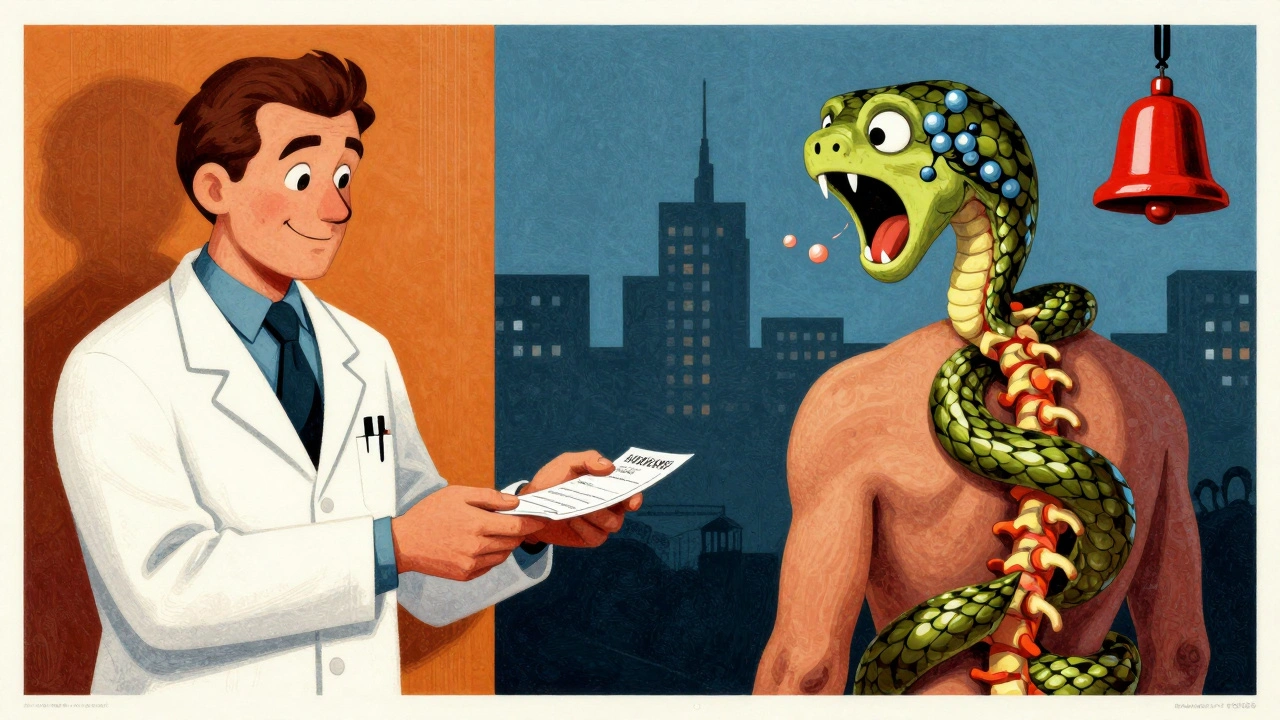
What Happens If You Get Serotonin Syndrome?
The good news? It’s treatable - if caught early. Standard protocol:- Stop tramadol and any other serotonergic drug
- Give benzodiazepines (like lorazepam) to calm agitation and reduce muscle spasms
- Use cyproheptadine - an antihistamine that blocks serotonin - as the first-line antidote (12 mg orally, then 2 mg every 2 hours if needed)
- Control fever with cooling measures and IV fluids
Alternatives to Tramadol
If you need pain relief and are on an antidepressant, there are safer options:- Tapentadol - works like tramadol but has almost no serotonin effect. A 2023 NIH study found it caused 63% fewer cases of serotonin syndrome.
- Acetaminophen or NSAIDs - for mild to moderate pain
- Physical therapy or nerve blocks - for chronic pain
- Non-opioid neuropathic pain drugs - gabapentin, pregabalin, or low-dose nortriptyline
The Bottom Line
Tramadol is not a "mild opioid." It’s a serotonin-affecting drug with opioid properties. That combination is dangerous - especially if you’re on antidepressants or have a history of mental health issues. The FDA added a black box warning in 2011. The CDC says it has "unique serotonergic risks not shared by other opioids." Yet, 39 million prescriptions were filled in 2022. If you’re prescribed tramadol, ask: "Is this safe with my other meds?" If you’re on an SSRI, SNRI, or triptan, it’s not. There are better choices. Don’t assume your doctor knows the risks. Don’t assume you’re safe because you’re taking "just one pill." Serotonin syndrome doesn’t care about your intentions. It only cares about the chemistry in your brain.Can tramadol cause serotonin syndrome by itself?
Yes. While most cases involve combinations with antidepressants, there are documented cases of serotonin syndrome from tramadol alone - even at standard doses. A 63-year-old woman developed full symptoms after taking 100 mg twice daily with no other serotonergic drugs. This is why tramadol is considered uniquely risky among opioids.
What antidepressants interact with tramadol?
All SSRIs (fluoxetine, sertraline, escitalopram), SNRIs (venlafaxine, duloxetine), MAOIs (phenelzine, selegiline), and even some migraine drugs called triptans (sumatriptan, rizatriptan). Tramadol also interacts with St. John’s Wort, certain antibiotics like linezolid, and some cough syrups containing dextromethorphan. Always check with your pharmacist before combining any new medication.
How long after stopping tramadol is it safe to start an SSRI?
Wait at least 7 days after your last tramadol dose before starting an SSRI. Tramadol and its active metabolite can stay in your system for up to a week. For long-acting formulations or if you’re a poor CYP2D6 metabolizer, wait 10-14 days. Never rush this - serotonin syndrome can develop even days after stopping tramadol if an SSRI is introduced too soon.
Is tapentadol really safer than tramadol?
Yes. Tapentadol works like tramadol for pain but doesn’t block serotonin reuptake significantly. A 2023 NIH study comparing the two in 2,500 patients found serotonin syndrome occurred in just 0.4% of tapentadol users versus 1.1% of tramadol users - a 63% reduction. It’s now recommended as a safer alternative for patients on antidepressants.
What should I do if I think I have serotonin syndrome?
Stop taking tramadol immediately. Call 911 or go to the nearest emergency room. Do not wait to see if it gets better. Symptoms like high fever, muscle rigidity, or confusion can worsen rapidly. Bring a list of all your medications. Early treatment with cyproheptadine and benzodiazepines can prevent death.
Are there genetic tests to check if I’m at higher risk?
Yes. A CYP2D6 genetic test can tell you if you’re a poor, intermediate, extensive, or ultra-rapid metabolizer. About 7-10% of white people are poor metabolizers - meaning tramadol builds up dangerously in their system. If you’re planning long-term tramadol use, ask your doctor about this test. It’s covered by many insurance plans.
Charles Moore
December 2, 2025 AT 02:41Been on tramadol for years for chronic back pain. Never knew about the serotonin risk until my pharmacist flagged it when I started sertraline. Scared the hell out of me. Switched to tapentadol last month-no more tremors, no more weird anxiety spikes. Honestly, if your doc didn’t mention this, they’re probably just going by the script and not the science.
Always ask for the CYP2D6 test. It’s cheap, it’s covered, and it could save your life.
Kara Bysterbusch
December 3, 2025 AT 20:54As someone who has navigated the labyrinthine world of psychiatric pharmacology and chronic pain management, I find this exposition not merely informative but profoundly necessary. The confluence of serotonergic agents with tramadol constitutes a pharmacological minefield that remains woefully under-communicated to the lay public.
It is astonishing that, despite the FDA’s black box warning and a wealth of peer-reviewed literature, this drug continues to be prescribed with the casualness of an over-the-counter analgesic. One must question the integrity of medical education when such a critical pharmacodynamic distinction remains obscured.
Moreover, the disparity in prescribing patterns between nations-where the EMA is contemplating restrictions while U.S. prescribers remain largely oblivious-is emblematic of a broader systemic failure in pharmacovigilance.
vinoth kumar
December 5, 2025 AT 16:07Bro this is wild. I was on tramadol for my sciatica and also taking fluoxetine because of anxiety. Felt like I was vibrating all the time. Thought I was just stressed. Then one day I got a fever and couldn’t stop shaking-thought I had the flu. Went to ER and they were like, ‘You’re lucky you didn’t die.’
Now I’m on gabapentin and it’s way better. No more brain zaps. Also, my mom’s 70 and they gave her tramadol for arthritis-she’s on citalopram. I told her to ask her doctor to switch. She didn’t believe me until I showed her this post.
bobby chandra
December 6, 2025 AT 15:46Let me be crystal clear: tramadol is not a painkiller-it’s a serotonin grenade with a fake opioid label. The fact that 39 million prescriptions were filled in 2022 while doctors sleepwalk through the risks is a national disgrace.
Tapentadol isn’t just ‘safer’-it’s the *only* responsible choice if you’re on an SSRI. Why are we still peddling a drug that’s been proven to induce life-threatening reactions at standard doses? Because it’s cheap. Because Big Pharma doesn’t care. Because your doctor’s EHR doesn’t pop up a warning.
Stop trusting algorithms. Start asking questions. Demand the CYP2D6 test. If your prescriber rolls their eyes, find a new one.
Archie singh
December 8, 2025 AT 13:43Tramadol? That’s the drug for people too lazy to get real pain management. You’re on antidepressants and still taking it? Congrats, you’re a walking clinical case study. Your brain is basically a faulty circuit board and you’re throwing gasoline on it.
And no, your ‘mild’ dose doesn’t matter. Serotonin syndrome doesn’t negotiate. It doesn’t care if you ‘just took one pill.’ You’re not special. You’re not immune. You’re just statistically doomed.
Stop pretending this is normal. Get off it. Or don’t. I don’t care. But don’t come crying when you’re in the ICU with a 41°C fever and your family’s signing your DNR.
Jim Schultz
December 10, 2025 AT 04:22Okay, let’s be real-this whole post reads like a medical school lecture written by someone who’s never met a patient. Yes, tramadol has risks. So does aspirin. So does coffee. So does breathing.
Most people who take tramadol with SSRIs don’t get serotonin syndrome. The data shows it’s rare. But you? You’re gonna scare the hell out of every depressed person with back pain who just wants to get through the day.
And tapentadol? It’s more expensive. It’s not covered by half the insurance plans. And guess what? People are dying from uncontrolled pain because you want them to ‘ask questions’ instead of just giving them something that works.
Balance. Not fear. We need balance.
Kidar Saleh
December 11, 2025 AT 22:57I’ve seen this happen twice in my clinic in London. Two elderly patients-both on citalopram, both on tramadol for osteoarthritis. One had a seizure. The other ended up in delirium for a week. Both were misdiagnosed as ‘delirium due to infection’ until the pharmacist noticed the drug combo.
It’s not just about the chemistry. It’s about the silence. Doctors don’t talk about this. Pharmacists don’t always catch it. Patients don’t know to ask. We’re failing them.
That’s why I now print out a one-page handout for every patient prescribed tramadol. It’s simple: ‘Are you on an antidepressant? If yes, do not take tramadol.’ I’ve saved lives with that piece of paper.
Chloe Madison
December 13, 2025 AT 11:48My grandma was on tramadol and Lexapro. She started talking to her dead husband, sweating buckets, and shaking like she had Parkinson’s. We thought it was dementia. Turned out it was serotonin syndrome. She was in the hospital for five days.
They didn’t even ask her what meds she was on. Just gave her more painkillers. I cried for three days.
If you’re on any antidepressant-any-ask your doctor about tramadol. Don’t wait. Don’t assume. Just ask. And if they say ‘it’s fine,’ get a second opinion. Your life isn’t worth the risk.